
Last Updated on July 8, 2026
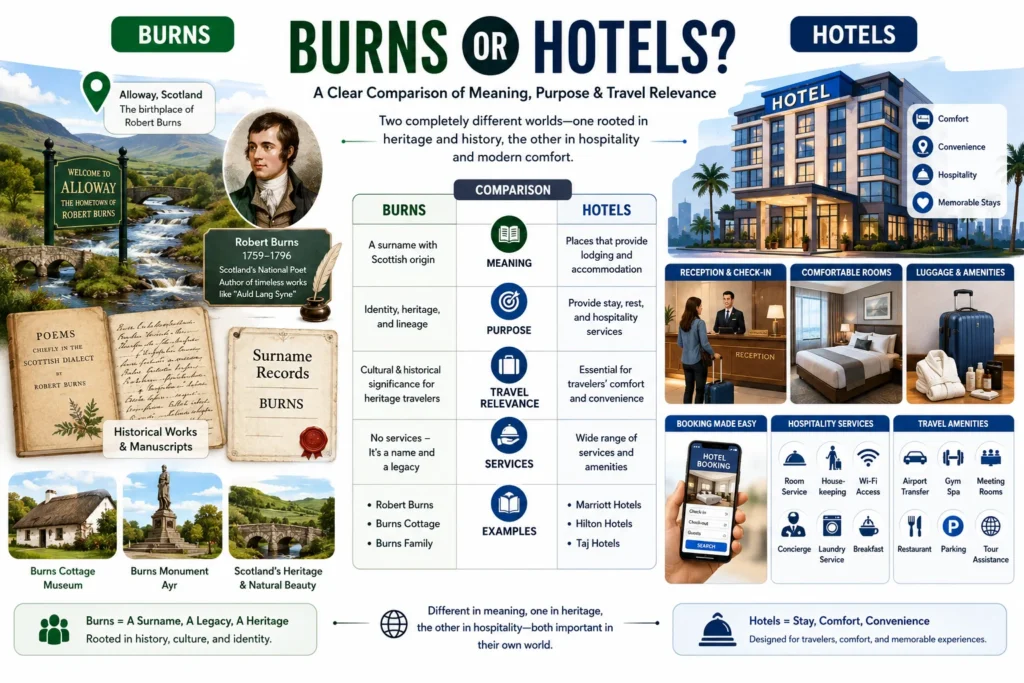
The phrase “burns or hotels” often causes confusion because Burns and Hotels can refer to different surnames, businesses, places, or entities depending on context. In most comparison searches, people are usually trying to understand whether a location, accommodation option, brand, or reference associated with Burns differs from one associated with Hotels and which choice best fits their needs.
The term burns or hotels may seem simple, but many people search for it because they are unsure what it means in a specific context. Sometimes it appears when comparing accommodation options. Other times it may involve names, brands, businesses, travel planning, or local references.
When people search for burns or hotels, they usually want a quick answer. They want to know the difference, when to use one term instead of the other, and whether the comparison even makes sense.
Understanding the meaning behind the search can help travelers, researchers, students, and everyday users make better decisions. It also prevents misunderstandings when reading travel guides, booking accommodation, or discussing locations.
This guide explains everything about burns or hotels in clear language. You will learn definitions, practical examples, advantages and disadvantages, common mistakes, regional usage, comparisons, exercises, and frequently asked questions. By the end, you will have a complete understanding of the topic and know how to interpret the phrase correctly in different situations.
Quick Answer
The answer depends on the context.
| TermGeneral Meaning | |
|---|---|
| Burns | Often a surname, place name, stream, geographic feature, business name, or reference to a person |
| Hotels | Accommodation establishments that provide lodging and services for travelers |
If you are choosing accommodation, hotels refer to places where guests stay overnight.
If Burns refers to a location, hotel name, district, road, landmark, or business, then the comparison becomes more specific.
The key is understanding the context in which the phrase is used.
Understanding Burns or Hotels
Before comparing the two terms, it helps to understand each separately.
What Does Burns Mean?
The word “burns” can have several meanings:
- A type of injury caused by heat, chemicals, electricity, or radiation.
- A surname.
- A geographic term in some regions, especially Scotland, where a burn means a small stream.
- A business or place name.
- A reference to a location associated with a person named Burns.
Examples:
- Burns Street
- Burns District
- Burns Hotel
- Burns Creek
- Burns Medical Center
Because the term has many meanings, context is important.
What Does Hotels Mean?
Hotels are commercial establishments that provide accommodation for travelers.
Typical hotel services include:
- Rooms
- Housekeeping
- Reception services
- Restaurants
- Wi-Fi
- Parking
- Conference facilities
Hotels are found worldwide and range from budget properties to luxury resorts.
Examples include:
- Airport hotels
- Boutique hotels
- Luxury hotels
- Business hotels
- Resort hotels
Why People Search for Burns or Hotels
There are several reasons why people search this phrase.
Travel Planning
Someone may be comparing:
- A place called Burns
- Nearby hotels
- Hotels with Burns in the name
Local Searches
People may be searching for:
- Burns accommodation
- Burns hotels
- Hotels near Burns
- Burns area lodging
Academic Research
Researchers may encounter the terms in historical documents and want clarification.
Online Booking
Travelers frequently compare locations and accommodation options before making reservations.
Burns vs Hotels: Key Differences
| Feature | Burns | Hotels |
|---|---|---|
| Category | Name, place, stream, injury, surname, business | Accommodation service |
| Purpose | Depends on context | Provides lodging |
| Industry | Multiple industries | Hospitality |
| Global Recognition | Context dependent | Universally recognized |
| Services Provided | Not necessarily | Accommodation and guest services |
| Travel Relevance | Location or destination related | Essential travel accommodation |
The biggest difference is that Burns is a broad term with multiple meanings, while Hotels refers specifically to lodging establishments.
Definition and Explanation
Burns as a Geographic Term
In Scotland and some other regions, a burn is a small stream.
Examples include:
- Mountain burns
- Rural burns
- Seasonal burns
Travelers exploring natural landscapes may encounter these features.
Burns as a Surname
Burns is a common surname.
Examples:
- Families named Burns
- Businesses named after Burns
- Historical figures with the surname
Hotels as Hospitality Businesses
Hotels exist to accommodate travelers.
A hotel generally provides:
- Sleeping facilities
- Guest services
- Security
- Food and beverages
- Customer support
This makes hotels a vital part of the tourism industry.
Types of Hotels
Understanding hotel categories helps when evaluating accommodation choices.
Budget Hotels
Designed for affordability.
Benefits:
- Lower prices
- Essential services
- Convenient locations
Business Hotels
Serve corporate travelers.
Features:
- Meeting rooms
- Business centers
- Fast internet
Luxury Hotels
Provide premium experiences.
Features:
- Spa facilities
- Fine dining
- Concierge services
Resort Hotels
Focus on recreation.
Features:
- Beaches
- Pools
- Entertainment activities
Boutique Hotels
Offer unique and personalized experiences.
Features:
- Distinct design
- Smaller size
- Customized service
Advantages and Disadvantages
Advantages of Hotels
| Advantage | Explanation |
|---|---|
| Convenience | Easy accommodation |
| Safety | Security measures |
| Comfort | Professional facilities |
| Services | Housekeeping and dining |
| Accessibility | Available worldwide |
Disadvantages of Hotels
| Disadvantage | Explanation |
|---|---|
| Cost | Can be expensive |
| Availability | Limited during peak seasons |
| Extra Fees | Parking and service charges |
| Crowds | Busy tourist periods |
Advantages of Burns Locations
If Burns refers to a town, district, or geographic area:
| Advantage | Explanation |
|---|---|
| Local Character | Unique culture |
| Scenic Areas | Natural attractions |
| Historical Interest | Heritage value |
Disadvantages of Burns Locations
| Disadvantage | Explanation |
|---|---|
| Limited Facilities | Fewer services |
| Less Accessibility | May be remote |
| Accommodation Shortages | Fewer lodging options |
Real World Examples
Example 1: Traveler Searching for Burns Hotels
A traveler plans to visit a place called Burns.
They search:
- Burns hotels
- Hotels near Burns
- Best hotels in Burns
In this case, Burns is the destination and hotels are the accommodation options.
Example 2: Historical Research
A student reads about Burns Creek.
The student then searches for nearby hotels before visiting the location.
Again, the two terms serve different purposes.
Example 3: Business Trip
A professional traveling to a Burns industrial area may compare:
- Hotels close to Burns business district
- Hotels with conference facilities
The goal is convenience and accessibility.
Regional and Global Usage
North America
Burns may refer to:
- Cities
- Counties
- Roads
- Businesses
Hotels are widely used throughout travel and tourism.
Europe
Burns is often associated with:
- Scottish geographic terminology
- Historical references
- Family names
Hotels remain a universal accommodation option.
Asia
The word Burns is typically encountered through:
- International business names
- Personal names
- Tourist references
Hotels continue to dominate the hospitality market.
Australia and New Zealand
Burns can appear as:
- Place names
- Business names
- Geographic references
Hotels range from budget lodgings to luxury resorts.
Choosing the Right Hotel Near Burns Locations
When selecting accommodation, consider the following.
Location
Choose hotels near:
- Attractions
- Business districts
- Transportation hubs
Price
Compare:
- Nightly rates
- Taxes
- Additional fees
Reviews
Look for:
- Cleanliness ratings
- Service quality
- Guest experiences
Amenities
Consider:
- Wi-Fi
- Parking
- Breakfast
- Swimming pool
Accessibility
Check:
- Airport access
- Public transportation
- Road connectivity
Common Mistakes
Many people misunderstand the phrase burns or hotels.
Mistake 1: Assuming They Are Similar Categories
Incorrect:
“Burns and hotels are the same thing.”
Correct:
Burns and hotels usually belong to different categories.
Mistake 2: Ignoring Context
Incorrect:
Assuming Burns always refers to a person.
Correct:
Burns may refer to a place, stream, business, injury, or surname.
Mistake 3: Booking Without Research
Incorrect:
Choosing the first hotel found online.
Correct:
Compare reviews, pricing, and amenities.
Mistake 4: Confusing Place Names with Hotel Names
Incorrect:
Assuming Burns is automatically a hotel.
Correct:
Verify whether Burns refers to a destination or accommodation property.
Burns or Hotels in Travel Planning
Travel planning often follows this sequence:
- Select destination.
- Research attractions.
- Search accommodation.
- Compare hotels.
- Book transportation.
- Finalize itinerary.
If Burns is the destination, hotels become the accommodation solution.
Sample Travel Scenario
Destination: Burns Region
Accommodation Search:
- Budget hotel
- Family hotel
- Luxury hotel
- Business hotel
Decision Factors:
- Price
- Comfort
- Location
- Guest ratings
Related Concepts and Comparisons
Hotels vs Motels
| Hotels | Motels |
|---|---|
| Multiple services | Basic services |
| Interior access | Exterior access |
| Suitable for longer stays | Suitable for short stays |
Hotels vs Resorts
| Hotels | Resorts |
|---|---|
| Focus on accommodation | Focus on vacation experiences |
| Urban and rural | Mostly leisure destinations |
Hotels vs Vacation Rentals
| Hotels | Vacation Rentals |
|---|---|
| Professional management | Private ownership |
| Standard services | Greater flexibility |
Burns vs Destinations
If Burns refers to a destination:
| Burns Location | Hotel Property |
|---|---|
| Travel destination | Accommodation |
| Attraction area | Lodging facility |
| Geographic reference | Hospitality business |
Practical Decision Framework
When evaluating burns or hotels, ask:
What does Burns refer to?
Possible answers:
- Place
- Person
- Stream
- Business
- Landmark
What is my goal?
Possible goals:
- Travel
- Research
- Booking accommodation
- Learning geography
Do I need accommodation?
If yes:
- Compare hotels.
- Check reviews.
- Evaluate amenities.
Exercises with Answers
Exercise 1
What is the primary purpose of a hotel?
A. To serve as a river
B. To provide accommodation
C. To act as a surname
D. To describe a stream
Answer: B
Exercise 2
True or False:
The word Burns always refers to a person.
Answer: False
Exercise 3
Which factor is most important when choosing a hotel?
A. Room availability
B. Location
C. Budget
D. All of the above
Answer: D
Exercise 4
A traveler visiting Burns should first identify:
A. The meaning of Burns in context
B. The color of the hotel
C. The hotel logo
D. The weather only
Answer: A
Exercise 5
Hotels belong to which industry?
A. Agriculture
B. Hospitality
C. Mining
D. Manufacturing
Answer: B
Exercise 6
True or False:
A burn in Scotland may refer to a small stream.
Answer: True
Exercise 7
Which option best describes hotels?
A. Lodging establishments
B. Rivers
C. Mountains
D. Family names
Answer: A
Advanced Understanding
Context Determines Meaning
The most important lesson about burns or hotels is context.
The same word can mean different things depending on where and how it is used.
For example:
- Burns Creek
- Burns District
- Burns Hotel
- Burns Residence
Each phrase changes the meaning of Burns.
Search Intent Matters
When analyzing online searches, intent is critical.
Possible intents include:
- Accommodation booking
- Geographic research
- Historical learning
- Business information
Understanding intent leads to better search results and better decisions.
Hospitality Industry Perspective
Hotels are a major component of tourism.
Benefits include:
- Employment generation
- Economic growth
- Visitor support
- Business travel facilitation
This makes hotels essential infrastructure in many destinations.
FAQs
What does burns or hotels mean?
The phrase generally compares or references Burns and hotels in a specific context. Burns may refer to a place, name, stream, or business, while hotels provide accommodation.
Is Burns a hotel?
Not necessarily. Burns could be a location, surname, geographic feature, business, or hotel name depending on context.
How do I find hotels near Burns?
Search using the destination name followed by hotel-related terms such as “hotels near Burns” or “best Burns hotels.”
What is the difference between Burns and hotels?
Burns is a context-dependent term, while hotels are lodging establishments designed for travelers.
Can Burns refer to a travel destination?
Yes. In some cases, Burns may be the name of a town, district, landmark, or geographic location.
Why do people search for burns or hotels?
Many users are trying to compare accommodation options, identify a destination, or understand a travel-related reference.
Are hotels better than vacation rentals?
It depends on your needs. Hotels offer professional services, while vacation rentals often provide more space and flexibility.
What should I check before booking a hotel?
Review location, pricing, amenities, cancellation policies, and guest ratings.
Can Burns refer to a natural feature?
Yes. In some regions, especially Scotland, a burn is a small stream.
What is the best way to understand burns or hotels?
Identify the context first. Once you know whether Burns is a place, name, or feature, the meaning becomes much clearer.
Conclusion
Understanding burns or hotels starts with recognizing that the two terms usually belong to different categories. The word Burns can refer to a location, surname, business, stream, landmark, or another context-specific reference. Hotels, on the other hand, are accommodation establishments that provide lodging and related services for travelers.
When encountering the phrase, always identify the intended meaning of Burns before making comparisons or decisions. This simple step eliminates confusion and helps you find accurate information. For travelers, Burns may be a destination while hotels provide the accommodation needed during the trip. For researchers or students, Burns may have historical, geographic, or personal significance.
The best approach is to evaluate context, clarify search intent, and compare available options carefully. If your goal is travel planning, focus on hotel location, amenities, reviews, and pricing. If your goal is research, determine exactly what Burns refers to in the source material. With these strategies, you can confidently interpret and use the phrase burns or hotels in any situation.

Justin Powell is a writer at GramBrix.com who focuses on grammar, clarity and effective communication, helping readers strengthen their language skills.