
Last Updated on July 8, 2026
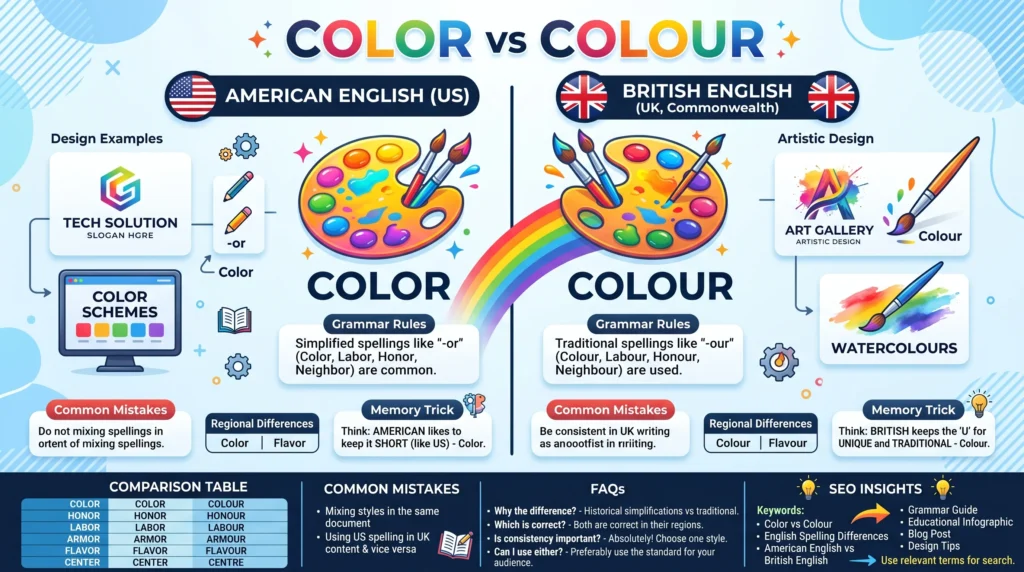
Both color and colour are correct spellings of the same word. The difference depends on the version of English being used. Color is the standard spelling in American English, while colour is preferred in British English, Canadian English, Australian English, and many other Commonwealth countries. The meaning, pronunciation, and usage are exactly the same.
The question of color or colour is one of the most searched spelling comparisons in English.
Many people notice that American websites often use color, while British and Canadian publications frequently use colour. This leads to confusion about which spelling is correct.
The answer is simple:
Both spellings are correct.
The difference is based on regional spelling conventions rather than grammar rules.
Consider these examples:
- My favorite color is blue. ✅
- My favourite colour is blue. ✅
Both sentences are correct. The first follows American English, while the second follows British English.
This guide explains:
- The meaning of color and colour
- American vs British spelling rules
- Examples
- Common mistakes
- SEO considerations
- FAQs
Quick Answer
| Word | Correct? | Common Region |
|---|---|---|
| Color | Yes | United States |
| Colour | Yes | United Kingdom, Canada, Australia |
| Both | Yes | Standard English |
Simple Summary
- Color = American English
- Colour = British English
- Both words mean exactly the same thing
What Does Color Mean?
Definition
Color refers to the visual appearance of an object based on the way it reflects or emits light.
Examples
- Red is a bright color.
- The walls have a beautiful color.
- Color can influence emotions.
American English Usage
Color is the preferred spelling in the United States.
Professional Applications
The spelling color appears in:
- American schools
- U.S. government documents
- American media
- Business communications
What Does Colour Mean?
Definition
Colour has the exact same meaning as color.
Examples
- Green is a calming colour.
- The room has a pleasant colour scheme.
- Colour plays an important role in design.
British English Usage
Colour is the standard spelling in British English.
International Usage
Colour is commonly used in:
- United Kingdom
- Canada
- Australia
- New Zealand
- South Africa
Main Difference Between Color and Colour
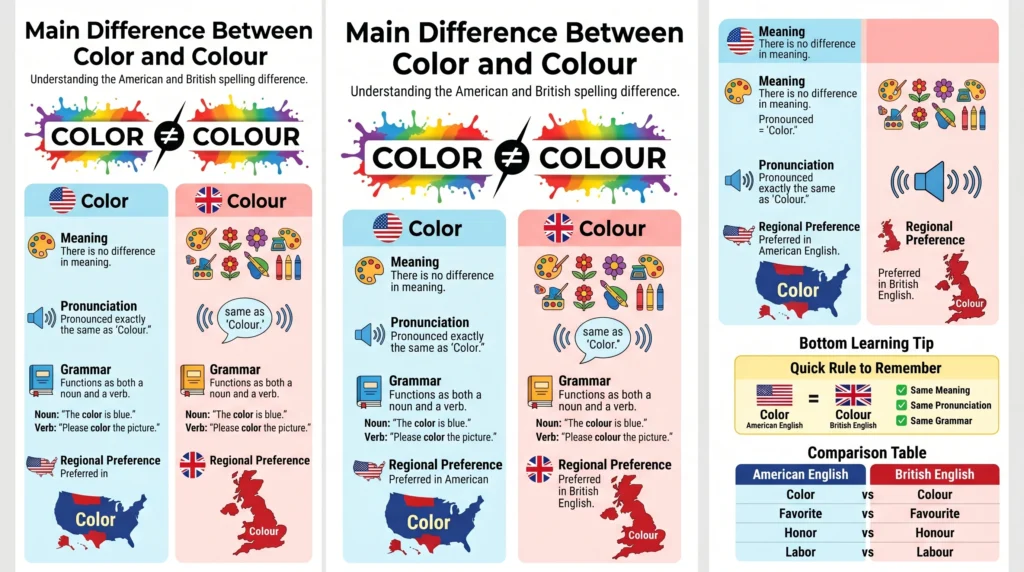
Meaning
There is no difference in meaning.
Pronunciation
Both words are pronounced exactly the same.
Grammar
Both function as nouns and verbs.
Regional Preference
Color
Preferred in American English.
Colour
Preferred in British English.
Comparison Table
| Feature | Color | Colour |
|---|---|---|
| Meaning | Same | Same |
| Pronunciation | Same | Same |
| American English | Preferred | Rare |
| British English | Less Common | Preferred |
| Canadian English | Sometimes | Common |
| SEO Search Volume | Higher Globally | Strong International Usage |
Why Are There Two Spellings?
Historical Background
The word originated from Latin through Old French.
Noah Webster’s Influence
American lexicographer Noah Webster simplified many spellings in American English.
Examples include:
- Color instead of colour
- Honor instead of honour
- Favor instead of favour
British Tradition
British English retained the original “-our” ending.
Modern English
Today, both forms are widely accepted.
Color in American English
Standard U.S. Spelling
American schools teach color as the correct spelling.
Examples
- My favorite color is green.
- The color of the sky is blue.
- The artist used vibrant colors.
Business Usage
Most American companies use color.
Academic Writing
Color is standard in U.S. educational institutions.
Colour in British English
Standard British Spelling
British schools teach colour.
Examples
- My favourite colour is green.
- The colour of the ocean changes throughout the day.
- Bright colours attract attention.
Publishing Standards
Most British publishers prefer colour.
Educational Usage
Colour is commonly used in British textbooks.
Is Color Wrong in British English?
The Short Answer
No.
Modern Recognition
British readers understand color without difficulty.
International Content
Many global websites use color because of American influence.
Style Preference
British publications generally still prefer colour.
Is Colour Wrong in American English?
Technically No
Colour is not incorrect.
Practical Usage
However, it appears unusual in American writing.
Reader Expectations
Most American readers expect color.
Professional Writing
Color is usually preferred for U.S. audiences.
Common Examples of Color
Art
- Color affects visual perception.
Marketing
- Brand colors influence consumer behavior.
Design
- Color combinations create mood.
Education
- Children learn colors early in life.
Common Examples of Colour
Art
- Colour enhances creativity.
Design
- Colour theory helps designers create harmony.
Photography
- Colour correction improves image quality.
Fashion
- Colour choices influence style.
Common Mistakes People Make
Assuming One Spelling Is Wrong
Both spellings are correct.
Mixing Styles
Avoid switching between color and colour in the same article.
Ignoring Audience
Choose the version preferred by your target readers.
Inconsistent Branding
Brands should maintain one spelling style.
Color vs Colour in Academic Writing
American Universities
Usually require color.
British Universities
Usually require colour.
International Journals
Either spelling may be accepted depending on style guidelines.
Student Assignments
Follow your institution’s preferred standard.
Color vs Colour in SEO
Search Volume
Color generally receives higher global search volume.
International Reach
Colour remains highly searched in Commonwealth countries.
Content Optimization
Many successful articles mention both spellings naturally.
SEO Recommendation
Target color or colour as the primary keyword and explain the regional distinction.
Related American vs British Spellings
Color or Colour
Most famous spelling variation.
Favor or Favour
Another common difference.
Honor or Honour
Frequently seen in academic writing.
Neighbor or Neighbour
Popular regional spelling distinction.
Which Spelling Is More Common?
Internet Usage
Color appears more frequently online.
American Influence
U.S.-based content contributes significantly to search volume.
International Publishing
Colour remains dominant in many countries.
Overall Trend
Color tends to generate more global traffic.
How to Remember the Difference
Geography Rule
United States → Color
United Kingdom → Colour
The U Rule
British English often keeps the letter U.
Examples:
- Colour
- Favour
- Honour
American Simplification
American English often removes the U.
Examples:
- Color
- Favor
- Honor
Easy Formula
US = Color
UK = Colour
Color and Colour as Verbs
Color as a Verb
Examples:
- Please color the picture.
- The artist colored the canvas.
Colour as a Verb
Examples:
- Please colour the drawing.
- The artist coloured the artwork.
Same Meaning
The verb meaning remains identical.
Exercises With Answers
Exercise 1
Which spelling is preferred in American English?
Answer: Color
Exercise 2
Which spelling is preferred in British English?
Answer: Colour
Exercise 3
Do color and colour have different meanings?
Answer: No
Exercise 4
Which version contains the letter U?
Answer: Colour
Exercise 5
Are both spellings correct?
Answer: Yes
FAQs
Is it color or colour?
Both are correct. Color is American English, while colour is British English.
Which spelling is used in the United States?
Color.
Which spelling is used in the United Kingdom?
Colour.
Do color and colour mean the same thing?
Yes. They have identical meanings.
Is colour wrong in American English?
No, but it is uncommon.
Is color wrong in British English?
No, but colour is generally preferred.
Which spelling is better for SEO?
Color generally has higher global search volume, but including both spellings can improve international reach.
Can I use both spellings in one article?
It’s best to stay consistent and use one style throughout.
Why did American English remove the U?
American spelling reforms promoted simpler spellings.
Will readers understand both versions?
Yes. Both spellings are widely recognized worldwide.
Conclusion
The answer to color or colour is straightforward:
Both spellings are correct.
The difference is regional:
- Color is preferred in American English.
- Colour is preferred in British English and many Commonwealth countries.
Key takeaways include:
- Both words have the same meaning and pronunciation.
- Neither spelling is grammatically incorrect.
- Audience location should guide your choice.
- Consistency matters more than the spelling itself.
- Color generally receives higher global search volume.
For blogging, academic writing, business communication, and SEO in 2026, understanding the distinction between color and colour helps ensure accuracy and professionalism.

Victoria Lane is a grammar-focused writer at GramBrix.com, passionate about helping readers master the rules of language. She provides clear explanations and practical examples that make writing more accurate, polished and confident.