
Last Updated on July 7, 2026
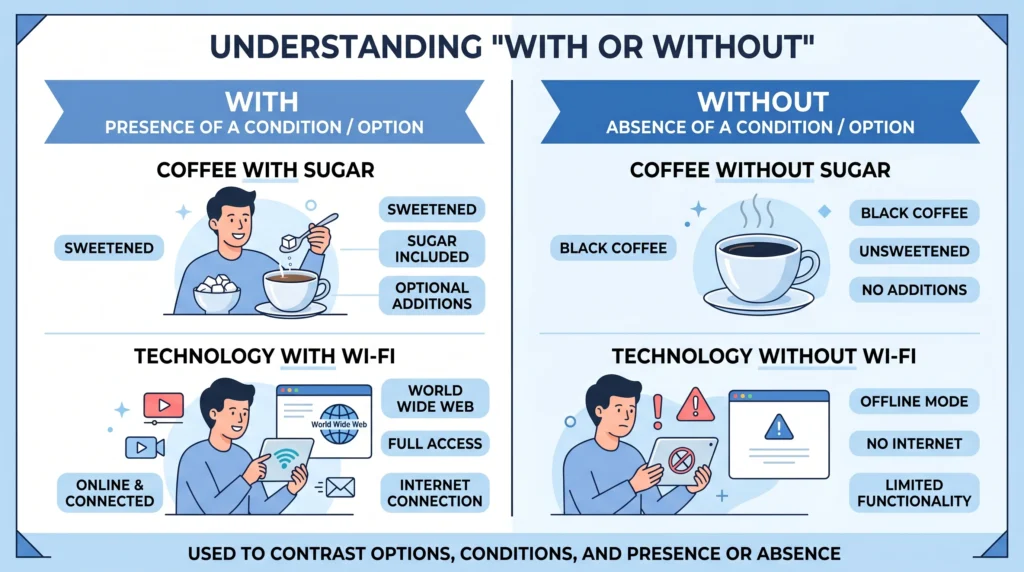
With or without is a common English phrase used to compare two situations, choices, or conditions. It helps show whether something happens in the presence or absence of another thing. The phrase is widely used in daily conversation, writing, advertising, and decision-making because it creates clear comparisons.
The phrase “with or without” may look simple, but it is used in many different ways in English. People use it while making choices, giving instructions, comparing situations, or expressing independence.
For example:
- Coffee with or without sugar
- Traveling with or without insurance
- Success with or without support
Because the phrase is so common, many English learners use it naturally without fully understanding the grammar behind it. Others struggle with sentence structure or punctuation when writing it formally.
The good news is that “with or without” is easy to learn once you understand its purpose.
In this guide, you will learn:
- The meaning of with or without
- Grammar rules
- Common sentence patterns
- Real-life examples
- Mistakes to avoid
- Practice exercises with answers
The explanations are simple, practical, and beginner-friendly.
Quick Answer
| Phrase | Meaning |
|---|---|
| With | In the presence of something |
| Without | In the absence of something |
| With or Without | Both possible conditions |
Simple Summary
“With or without” is used to compare two possibilities:
- One where something exists
- One where it does not
Example:
- I will go with or without you.
Meaning:
- I will go either way.
What Does “With or Without” Mean?
Basic Definition
The phrase “with or without” introduces two conditions:
- Presence of something
- Absence of something
It shows that the main action can happen in both situations.
Simple Example
- She drinks tea with or without milk.
Meaning:
- She drinks tea in both situations.
Grammar Structure of With or Without
Standard Sentence Pattern
The most common structure is:
- Subject + verb + with or without + noun
Example:
- We can continue with or without approval.
Question Form
Example:
- Would you like pizza with or without cheese?
Instruction Form
Example:
- Submit the form with or without additional documents.
Everyday Examples of With or Without
Food and Drinks
People often use the phrase while ordering food.
Examples:
- Burger with or without onions
- Coffee with or without sugar
- Salad with or without dressing
Travel Situations
Examples:
- Travel with or without insurance
- Driving with or without GPS
Relationships and Motivation
Examples:
- I will succeed with or without support.
- She continued with or without encouragement.
Real World Usage
In Advertising
Businesses use “with or without” to show flexibility.
Examples:
- Available with or without subscription
- Cars sold with or without premium package
In Education
Teachers may say:
- Complete the task with or without help.
In Technology
Software services may offer:
- Apps with or without internet access
Difference Between “With” and “Without”
| Word | Meaning |
|---|---|
| With | Accompanied by something |
| Without | Lacking something |
Example Comparison
- Coffee with sugar
- Coffee without sugar
The meaning changes completely depending on the condition.
Why “With or Without” Is Popular in English
Easy Comparison Tool
The phrase quickly presents two possibilities.
Flexible Communication
It works in:
- Casual conversation
- Business writing
- Advertising
- Formal instructions
Strong Emotional Meaning
Sometimes the phrase shows independence.
Example:
- I will move forward with or without approval.
This creates emotional emphasis.
Common Mistakes People Make
Incorrect Word Order
Incorrect:
- Without or with
Correct:
- With or without
Missing the Second Condition
Incorrect:
- I can work with or.
Correct:
- I can work with or without assistance.
Overusing the Phrase
Repeating “with or without” too often can make writing sound unnatural.
Confusing Meaning
Some learners think both conditions happen together.
Actually, the phrase means either possibility works.
Formal vs Informal Usage
Formal Usage
- Employees may work remotely with or without manager approval.
Informal Usage
- I’m going with or without them.
Both forms are correct depending on context.
Related Grammar Concepts
Either Or
“Either or” focuses on choosing one option.
Example:
- Either tea or coffee
Whether Or Not
“Whether or not” introduces uncertainty.
Example:
- Whether or not they agree
With vs Along With
“With” shows presence.
“Along with” often adds extra information.
Advantages of Using the Phrase Correctly
Clear Communication
The phrase makes choices easy to understand.
Better Writing Flow
It helps compare situations naturally.
More Natural English
Native speakers use this phrase regularly.
Exercises With Answers
Exercise 1
Choose the correct sentence:
A. With or without support, I will continue.
B. Without or with support, I will continue.
Answer
✅ A
Exercise 2
Fill in the blank:
Would you like tea with or ______ sugar?
Answer
✅ without
Exercise 3
What does “with or without” show?
Answer
✅ Two possible conditions
Exercise 4
Which sentence is correct?
A. He traveled with or without luggage.
B. He traveled without or with luggage.
Answer
✅ A
Exercise 5
Can “with or without” be used in formal writing?
Answer
✅ Yes
Real Life Communication Examples
Workplace Example
- The meeting will happen with or without the manager.
Fitness Example
- You can exercise with or without equipment.
Technology Example
- The app works with or without Wi-Fi.
Family Example
- We are going on vacation with or without the weather improving.
SEO and Content Writing Usage
Why Marketers Use It
The phrase helps create flexible search intent.
Examples:
- Travel with or without visa
- Coffee with or without caffeine
- VPN with or without subscription
Better User Engagement
Headlines using comparisons often attract more clicks because readers want clear choices.
FAQs
What does with or without mean?
It means something can happen in both conditions: with something present or absent.
How do you use with or without in a sentence?
Example:
- I will attend the event with or without an invitation.
Is with or without grammatically correct?
Yes. It is a very common and correct English phrase.
Can with or without be used formally?
Yes. It works in both formal and informal writing.
What is the difference between with and without?
“With” means something is included. “Without” means it is absent.
Why is with or without used in advertising?
It helps show flexible product or service options.
Can with or without show independence?
Yes. It can express determination or emotional strength.
Is the phrase common in spoken English?
Yes. Native speakers use it frequently.
Can I use commas with with or without?
Sometimes, depending on sentence structure and style.
What is a similar phrase to with or without?
“Whether or not” is somewhat similar in meaning.
Conclusion
The phrase “with or without” is simple, flexible, and extremely common in English communication. It helps compare situations where something may or may not be present, making conversations and writing much clearer.
People use the phrase in:
- Daily conversation
- Business communication
- Advertising
- Education
- Technology
Understanding how it works improves grammar, writing clarity, and natural English fluency.
One reason the phrase remains popular is its emotional and practical power. It can express flexibility, confidence, independence, or simple comparison depending on context.
The key is remembering the correct structure:
- With or without + noun
Once you practice a few examples, using the phrase becomes very natural in both spoken and written English.

Kevin Brooks is a grammar specialist at GramBrix.com, dedicated to helping readers understand language rules with clarity and confidence. He simplifies complex grammar concepts through practical examples and easy explanations.