
Last Updated on July 5, 2026
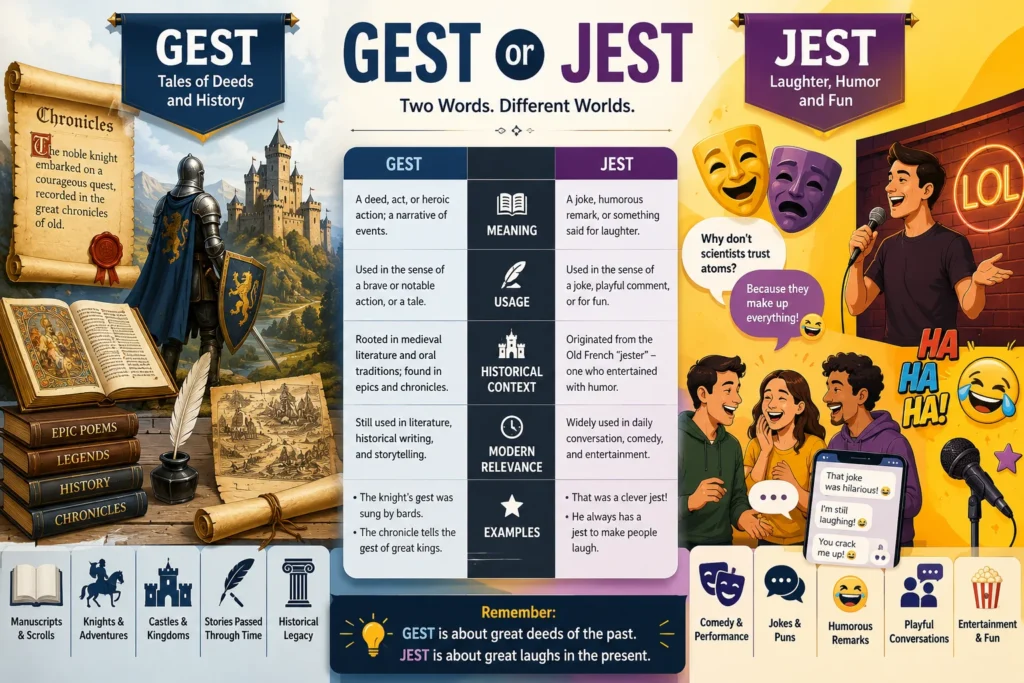
Gest and jest are two different English words that sound similar but have very different meanings. Jest refers to a joke, humorous remark, or playful comment, while gest is an old and rare word that traditionally means a tale, adventure, or heroic story. In modern English, jest is common, while gest is mostly found in historical and literary contexts.
Many English words look or sound alike. This often creates confusion for writers, students, and language learners. One such pair is gest or jest.
At first glance, these words seem almost identical. They differ by only one letter. Their pronunciation can also sound similar depending on accent and speaking style. Because of this, many people wonder whether they should write gest or jest in a sentence.
The confusion becomes even greater because one word is common in modern English while the other is rarely used. You may hear people talk about a joke “in jest,” but you rarely see the word “gest” outside old books and historical literature.
Understanding the difference is important for accurate writing and communication. Using the wrong word can change the meaning of a sentence or make your writing appear incorrect.
This guide explains everything you need to know about gest or jest, including definitions, examples, usage rules, history, common mistakes, exercises, and frequently asked questions. By the end, you will know exactly when to use each word with confidence.
Quick Answer
The difference between gest and jest is simple:
| Word | Meaning | Modern Usage |
|---|---|---|
| Gest | An old tale, heroic story, or adventure | Rare |
| Jest | A joke, humorous remark, or playful comment | Common |
| In Jest | Said as a joke | Very common phrase |
| Gest Literature | Medieval storytelling tradition | Historical use |
Easy Rule
Use jest when talking about humor, jokes, or playful comments.
Use gest only when discussing old literature, medieval stories, or historical texts.
What Does Gest Mean?
The word gest is an old English term.
Historically, it referred to:
- A tale
- A heroic adventure
- A narrative of exploits
- A medieval romance story
The word comes from older French and Latin roots related to deeds and actions.
Examples of Gest
- The knight’s gest described his adventures across the kingdom.
- Scholars studied the ancient gest preserved in medieval manuscripts.
- The poem was written in the style of a traditional gest.
Today, most people never use this word in everyday conversation.
Historical Importance of Gest
In medieval Europe, a gest often referred to stories about heroes and their deeds.
Examples included:
- Knightly adventures
- Royal journeys
- Military victories
- Religious pilgrimages
These stories entertained audiences before modern novels became common.
What Does Jest Mean?
The word jest refers to humor or joking.
It can be used as:
- A noun
- A verb
Jest as a Noun
A jest is a joke or funny remark.
Examples:
- Everyone laughed at his clever jest.
- Her jest lightened the mood.
Jest as a Verb
To jest means to joke.
Examples:
- He likes to jest with his friends.
- She was only jesting when she made that comment.
Common Phrase: In Jest
One of the most common uses is the phrase in jest.
Meaning:
- Said jokingly
- Not intended seriously
Examples:
- He said it in jest.
- The comment was made in jest, not as criticism.
Gest or Jest: Side by Side Comparison
| Feature | Gest | Jest |
|---|---|---|
| Meaning | Story or heroic tale | Joke or humorous remark |
| Part of Speech | Noun | Noun and verb |
| Frequency | Rare | Common |
| Modern Usage | Mostly historical | Everyday English |
| Literature | Medieval works | All forms of writing |
| Common Expression | None | In jest |
| Found in Conversation | Almost never | Frequently |
The Origins of Gest and Jest
Understanding the history of these words makes their difference easier to remember.
Origin of Gest
Gest comes from:
- Old French: geste
- Latin: gesta
These words referred to deeds, actions, and achievements.
Because many medieval stories focused on heroic deeds, the word gradually came to mean a narrative of those deeds.
Origin of Jest
Jest developed from older forms of the same root but evolved differently.
Over time, the meaning shifted from storytelling and entertainment toward humor and joking.
As language changed, jest became associated specifically with playful remarks and comedy.
This explains why the two words share historical roots but have very different modern meanings.
Why People Confuse Gest and Jest
Several factors contribute to confusion.
Similar Spelling
Only one letter differs.
- Gest
- Jest
A quick glance may not reveal the difference.
Similar Pronunciation
In many accents, the words sound very close.
Spell Checking Issues
Some spelling tools recognize both words as valid English terms.
As a result, software may not flag the mistake.
Rare Usage of Gest
Most people know jest but have never encountered gest.
When they see gest, they may assume it is a misspelling.
Real World Examples of Jest
Here are examples from daily life.
Workplace
- “I was only joking.”
- “I said that in jest.”
Family Conversation
- His jest made everyone laugh during dinner.
- She likes to jest with her siblings.
Social Media
- The comment was made in jest.
- Many users thought the joke was serious even though it was a jest.
Public Speaking
- The speaker opened with a light jest.
- A clever jest helped engage the audience.
Real World Examples of Gest
Although rare, gest still appears in certain contexts.
Academic Research
- Researchers analyzed a medieval gest from the twelfth century.
Literary Studies
- Students compared different versions of the heroic gest.
Historical Writing
- The manuscript preserved an ancient gest about a legendary warrior.
Museum Descriptions
- The exhibit featured illustrations from a famous medieval gest.
Regional and Global Usage
Usage in the United States
Jest remains recognizable, especially in formal writing.
Examples:
- “I speak in jest.”
- “The remark was made in jest.”
Gest is rarely encountered outside academic settings.
Usage in the United Kingdom
British English uses jest similarly.
The phrase in jest remains common in newspapers, literature, and conversation.
Usage in Canada
Canadians generally use jest the same way as Americans and British speakers.
Usage in Australia
Australian English recognizes jest, especially in formal or literary language.
Usage Worldwide
English learners around the world encounter jest far more frequently than gest.
Advantages and Disadvantages of Using Jest
Advantages
- Widely understood
- Common in speech
- Useful in formal and informal writing
- Adds precision when discussing humor
Disadvantages
- Can sound old fashioned in some contexts
- Often replaced by words like joke or kidding
Advantages and Disadvantages of Using Gest
Advantages
- Useful in literary discussions
- Precise historical meaning
- Valuable in medieval studies
Disadvantages
- Rarely understood
- Can confuse readers
- Not suitable for everyday communication
Common Mistakes with Gest or Jest
Mistake One
Incorrect:
- He said it in gest.
Correct:
- He said it in jest.
Reason:
The phrase is always in jest.
Mistake Two
Incorrect:
- The comedian told several funny gests.
Correct:
- The comedian told several funny jests.
Reason:
Humorous remarks are called jests.
Mistake Three
Incorrect:
- The medieval jest described a knight’s journey.
Correct:
- The medieval gest described a knight’s journey.
Reason:
A heroic story is a gest, not a jest.
Mistake Four
Incorrect:
- She gested with her friends.
Correct:
- She jested with her friends.
Reason:
The verb form comes from jest.
Memory Tricks for Remembering the Difference
Trick One: J for Joke
The word jest begins with J.
J also begins:
- Joke
- Joking
- Joyful
This helps you connect jest with humor.
Trick Two: G for Grand Story
The word gest begins with G.
Think:
- Grand tale
- Great adventure
This helps you remember its historical storytelling meaning.
Trick Three: The Phrase Test
If you can replace the word with “joke,” use jest.
Example:
- He said it as a joke.
- He said it in jest.
Gest or Jest in Literature
Literature offers some of the best examples of these words.
Medieval Literature
Many medieval texts are described as gests because they recount heroic deeds.
Examples include:
- Tales of knights
- Royal adventures
- Legendary battles
Modern Literature
Modern authors often use jest to indicate humor.
Example:
- The remark was intended as a jest.
Poetry
Poets sometimes use both words to create historical or humorous effects.
Related Words and Concepts
Understanding related terms can deepen your knowledge.
| Word | Meaning |
|---|---|
| Joke | Something said to cause laughter |
| Jest | Formal word for a joke |
| Humor | Quality of being funny |
| Satire | Humor used for criticism |
| Wit | Clever humor |
| Tale | Story or narrative |
| Legend | Traditional story |
| Chronicle | Historical record |
| Gest | Medieval heroic story |
Gest or Jest in Academic Writing
When to Use Gest
Use gest only when discussing:
- Medieval literature
- Historical narratives
- Literary analysis
- Ancient manuscripts
When to Use Jest
Use jest when discussing:
- Humor
- Comedy
- Literary tone
- Speech and conversation
Comparison with Similar Word Pairs
Complement vs Compliment
- Complement = completes something
- Compliment = praise
Stationary vs Stationery
- Stationary = not moving
- Stationery = writing materials
Gest vs Jest
- Gest = historical story
- Jest = joke
These pairs demonstrate why careful spelling matters.
How Dictionaries Treat Gest and Jest
Modern dictionaries usually label gest as:
- Archaic
- Historical
- Literary
Meanwhile, jest is labeled:
- Standard English
- Current usage
- Common vocabulary
This reflects how frequently each word appears today.
Exercises with Answers
Exercise One
Choose the correct word.
- He made the comment in ______.
- The medieval ______ described heroic deeds.
- Everyone laughed at the clever ______.
- The scholar translated an ancient ______.
Answers
- Jest
- Gest
- Jest
- Gest
Exercise Two
- The comedian told several gests.
- She said it in gest.
- The ancient jest described a knight.
- He gested with his friends.
Answers
- The comedian told several jests.
- She said it in jest.
- The ancient gest described a knight.
- He jested with his friends.
Exercise Three
Fill in the blanks.
- A humorous remark is called a ______.
- A medieval heroic story may be called a ______.
- The phrase “in ______” means jokingly.
- Literary historians often study a ______.
Answers
- Jest
- Gest
- Jest
- Gest
Advanced Understanding of Gest and Jest
Language evolves over time.
Centuries ago, storytelling and entertainment were closely linked. As English developed, words changed meaning and usage.
Gest remained tied to stories and heroic deeds.
Jest moved toward humor and playful communication.
This process is called semantic change. Many English words have followed similar paths.
Understanding this historical development helps explain why these words look related but function differently today.
When Should You Use Gest?
Use gest only if:
- You are discussing medieval literature.
- You are writing historical analysis.
- You are quoting old texts.
- You need the precise literary term.
For general audiences, you may need to explain the word because many readers will not know it.
When Should You Use Jest?
Use jest whenever you mean:
- Joke
- Humor
- Playful remark
- Funny statement
Examples:
- I spoke in jest.
- It was only a jest.
- He likes to jest with coworkers.
- Her jest relieved tension.
For modern English, jest is almost always the correct choice.
FAQs
What is the difference between gest or jest?
A gest is an old heroic story or narrative, while a jest is a joke or humorous remark.
Is gest a real word?
Yes. Gest is a legitimate English word, but it is archaic and mainly used in literary or historical discussions.
Is jest a real word?
Yes. Jest is a common English word meaning a joke or playful remark.
What does “in jest” mean?
It means something was said jokingly and not meant to be taken seriously.
Can I use gest instead of jest?
No. In modern English, these words have different meanings and are not interchangeable.
Why is gest rarely used today?
Modern English largely replaced it with words such as story, tale, narrative, and legend.
Which word is more common: gest or jest?
Jest is far more common in modern speech and writing.
How do I remember gest or jest?
Think “J for Joke.” If humor is involved, use jest.
Is the phrase “in gest” correct?
No. The correct phrase is in jest.
Do writers still use gest?
Yes, but mostly in academic, historical, and literary contexts involving medieval narratives.
Conclusion
The difference between gest or jest is easy to understand once you know their meanings. Jest is the modern and commonly used word that refers to a joke, humorous remark, or playful comment. It appears in everyday conversation, books, speeches, and expressions such as “in jest.” Gest, on the other hand, is an old literary term that refers to a heroic tale, adventure, or medieval narrative.
For most writers, students, and English learners, jest will be the word used far more often. If you are discussing humor, joking, or playful speech, choose jest. Reserve gest for historical, academic, or literary discussions involving medieval storytelling traditions.
A simple rule can help: J stands for Joke, so use Jest for humor. If the topic involves an ancient story or heroic narrative, gest is the correct choice. Learning this distinction will improve your writing accuracy and help you avoid one of English’s lesser known word confusions.

Kevin Brooks is a grammar specialist at GramBrix.com, dedicated to helping readers understand language rules with clarity and confidence. He simplifies complex grammar concepts through practical examples and easy explanations.