
Last Updated on August 21, 2026
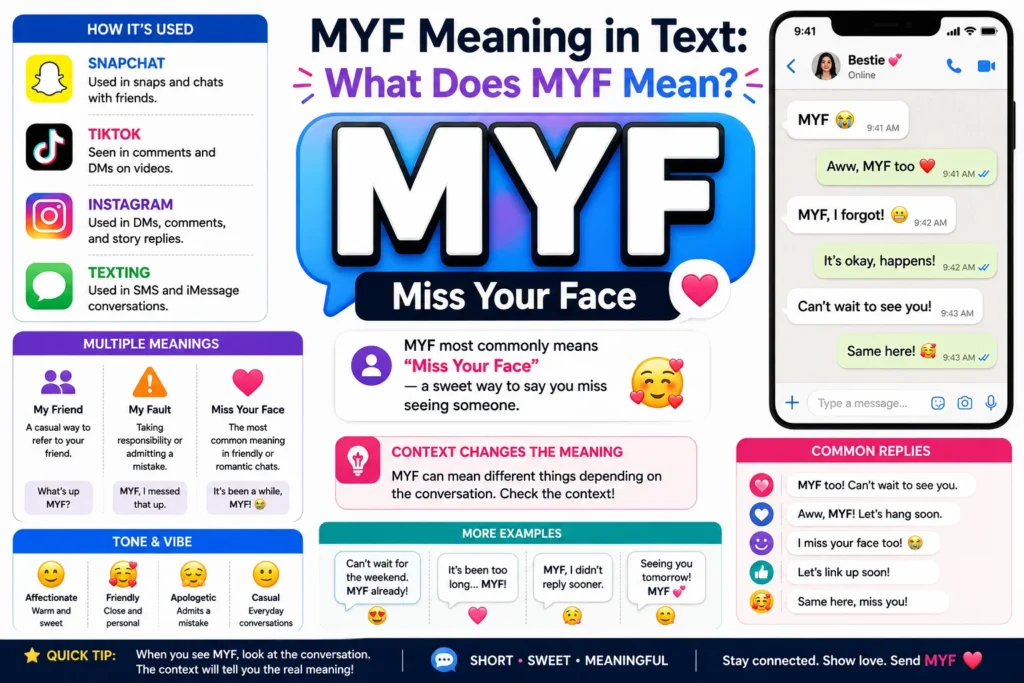
MYF usually means “Miss Your Face” in casual texting. It expresses that someone misses seeing another person. However, MYF can also mean “My Friend” or “My Fault,” so the surrounding message and relationship determine the intended meaning.
The myf meaning in text usually points to “Miss Your Face,” a casual phrase people use when they miss seeing someone. However, MYF does not have one universal definition. Its meaning can shift with the conversation, platform, and relationship between the people chatting.
That flexibility explains why this three letter abbreviation can cause confusion. For example, someone might send “MYF 😭” after looking at an old photo. In that situation, “Miss Your Face” makes sense. Another person might use MYF after making a mistake and mean “My Fault.” Some users also use it as shorthand for “My Friend.”
Therefore, context matters more than capitalization. “myf,” “MYF,” and “MyF” can represent the same intended phrase. Digital conversations rarely follow formal capitalization rules.
This guide explains the main interpretations, emotional nuances, platform differences, realistic conversations, alternative meanings, and natural replies. It also shows when you should avoid the abbreviation.
Quick Answer Box
| Meaning | Context | Primary Platforms | Example | Tone |
|---|---|---|---|---|
| Miss Your Face | Missing someone’s presence | Texting, Snapchat, Instagram | “MYF! We need to hang out soon.” | Warm, affectionate |
| My Friend | Addressing someone casually | Texts, DMs, group chats | “Hey MYF, you coming?” | Friendly |
| My Fault | Admitting a mistake | Texting and casual chats | “MYF, I forgot to call.” | Apologetic |
| Context specific | Private jokes or niche communities | Social media and messaging apps | “MYF 😂” | Depends on context |
What Does myf meaning in text Mean?
In casual online communication, myf meaning in text most commonly refers to “Miss Your Face.” The expression tells someone that you miss seeing them or spending time with them.
The phrase feels more personal than a simple “miss you.” “Miss Your Face” focuses on the person’s presence, appearance, or company. As a result, it often appears between people who already share some emotional familiarity.
For example:
“That old picture popped up today. MYF 🥹”
Here, the sender probably means “Miss Your Face.” The emotional context supports that interpretation.
Likewise:
“MYF! When are you coming back?”
Again, the phrase communicates longing or affection. The exclamation mark strengthens the emotional tone.
However, MYF is not a standardized acronym with one fixed meaning. Current online references give several interpretations, including “Miss Your Face,” “My Friend,” and “My Fault.”
That distinction matters. You should not automatically assume that every MYF means the same thing.
The Most Common Interpretation
“Miss Your Face” works especially well when the conversation involves:
- Missing someone
- Old photographs
- Memories
- Long-distance friendships
- Reconnecting
- Plans to meet
- Romantic or affectionate messages
- Emotional conversations
For example:
“It’s been forever. MYF ❤️”
The sender is likely expressing affection and saying they miss seeing you.
MYF as “My Friend”
Another interpretation is “My Friend.” Some users place the abbreviation directly before a person’s statement.
For example:
“MYF, you have to hear this story.”
In that context, the phrase functions more like “my friend” than “miss your face.”
This interpretation appears in some contemporary slang references, although usage is not universal.
Therefore, the sentence structure provides an important clue.
If MYF appears at the beginning of a sentence followed by advice, a question, or a joke, “My Friend” may fit better.
MYF as “My Fault”
MYF can also mean “My Fault.”
For example:
“MYF, I sent the wrong address.”
Here, the sender accepts responsibility for the mistake.
This interpretation becomes much easier to recognize when MYF appears alongside an apology, correction, or explanation. Some slang references identify “My Fault” as a possible texting interpretation.
Why Context Controls the Meaning
Internet abbreviations depend heavily on context. Unlike dictionary words, many slang abbreviations develop inside communities and personal conversations.
Therefore, three questions can help:
- What was being discussed?
- Who sent the message?
- What words appeared before or after MYF?
Suppose someone sends:
“MYF 😭 I haven’t seen you in months.”
“Miss Your Face” fits naturally.
Now consider:
“MYF, I completely forgot about the meeting.”
“My Fault” makes more sense.
Finally:
“MYF, you will not believe what happened.”
“My Friend” may fit the sentence better.
The surrounding language often gives you the answer.
Contextual Dynamics & Nuances of the Term
The emotional meaning of MYF changes depending on the relationship between the sender and recipient.
A close friend may use it casually. A romantic partner may use it affectionately. Someone you barely know may make the phrase feel unexpectedly personal.
Therefore, the same three letters can produce very different impressions.
Friendly Use
Among friends, “Miss Your Face” can sound warm without becoming overly serious.
For example:
“MYF! We need another coffee run soon.”
The message feels friendly and relaxed.
The sender is not necessarily making a romantic statement. They may simply miss spending time together.
Romantic or Flirty Use
A romantic partner or crush may use MYF in a more affectionate way.
For example:
“Can’t sleep. MYF 😭❤️”
The surrounding emojis and late night context can make the message feel more intimate.
However, the abbreviation itself does not automatically mean romantic interest.
That distinction is important. People often interpret slang based on the relationship rather than the abbreviation alone.
Playful Use
Friends may also exaggerate the phrase for humor.
“MYF!!! It has literally been three days 😂”
The dramatic punctuation makes the message playful.
Similarly, someone might comment “MYF 😭” under a friend’s throwback picture. The phrase can acknowledge nostalgia without carrying a serious emotional message.
Emotional Use
MYF can communicate genuine longing.
Consider:
“I know we just talked yesterday, but MYF.”
The sender emphasizes emotional closeness rather than simply requesting another conversation.
Consequently, tone depends on more than the acronym. Emojis, punctuation, timing, previous messages, and relationship status all contribute meaning.
Why Capitalization Does Not Matter Much
You may see:
- MYF
- myf
- Myf
- MyF
These forms usually reflect typing habits rather than different definitions.
People often type slang in lowercase because mobile messaging encourages fast, informal writing.
Therefore, do not treat capitalization as the primary clue.
Emojis Can Change the Tone
Consider these examples:
| Message | Likely Tone |
|---|---|
| “MYF” | Neutral or affectionate |
| “MYF 😭” | Emotional or playful |
| “MYF ❤️” | Affectionate |
| “MYF 😂” | Playful |
| “MYF!!” | Excited |
| “MYF, sorry” | Possibly “My Fault” |
The emoji does not provide a guaranteed definition. However, it gives you a useful emotional signal.
Real Life Conversation Examples Using myf meaning in text
The easiest way to understand myf meaning in text is to see how the abbreviation works inside complete conversations.
Example 1: Close Friends
Alex: “Just found our beach pictures from last summer.”
Jordan: “Omg 😭 MYF!”
Alex: “Same! We need another trip.”
Here, “Miss Your Face” fits naturally. The old photos create a nostalgic context.
Example 2: Long Distance
Mia: “How’s everything going in Texas?”
Sam: “Good, but MYF. Come visit already 😂”
Mia: “I know! I’m checking flights this weekend.”
The abbreviation expresses that Sam misses Mia’s presence.
Example 3: Romantic Context
Taylor: “You still awake?”
Chris: “Yeah. Can’t sleep.”
Taylor: “MYF ❤️”
Chris: “Miss you too.”
The heart emoji and intimate conversation make the affectionate interpretation clear.
However, MYF alone does not prove romantic interest. The surrounding relationship provides that information.
Example 4: Admitting a Mistake
Jordan: “Why did you send me the old address?”
Alex: “MYF 😭 I copied it from last year’s chat.”
Jordan: “Lol, no worries.”
Here, “My Fault” clearly fits.
The apology and explanation provide the necessary context.
Example 5: Friendly Address
Chris: “MYF, you need to see this video.”
Sam: “Send it 😂”
Here, “My Friend” can fit because the abbreviation addresses the recipient directly.
This example also shows why you should not assume that every MYF means “Miss Your Face.”
Platform Specific Breakdown
Different platforms encourage different styles of communication. Therefore, MYF can feel slightly different depending on where you encounter it.
How It Is Used on Snapchat
Snapchat encourages short messages, visual communication, emojis, photos, and quick replies.
That environment makes compact expressions useful.
You might see:
“MYF 😭”
after a friend sends an old picture.
You might also see:
“MYF! Come back.”
after someone posts a memory from a trip.
In Snapchat conversations, the surrounding Snap often provides more information than the abbreviation itself.
For example, a throwback selfie followed by “MYF” strongly supports “Miss Your Face.”
A message about forgetting something may instead support “My Fault.”
Therefore, inspect the Snap, caption, and preceding messages before deciding.
The Role of myf meaning in text on TikTok
TikTok communication often combines comments, captions, direct messages, videos, sounds, memes, and inside jokes.
Because of that variety, MYF can have less predictable meaning.
A comment such as:
“MYF 😭”
under a friend’s old video may express nostalgia.
However, a creator or commenter might use MYF as a private shorthand that their followers understand.
TikTok also has a strong culture of evolving slang. Not every abbreviation becomes universal. Some remain limited to particular friend groups or communities.
Therefore, avoid assuming that an abbreviation is a platform wide standard simply because you saw it once.
Current references describe MYF as relatively uncommon compared with highly established abbreviations.
Instagram and Texting Dynamics
Instagram DMs often resemble ordinary text conversations.
People send:
- Reactions
- Memes
- Photos
- Voice messages
- Short replies
- Throwback posts
- Flirty messages
Consequently, MYF may appear naturally in several contexts.
For example:
“Saw your vacation story. MYF!”
This likely communicates affection or missing the person.
Meanwhile:
“MYF, I totally forgot to tag you.”
could mean “My Fault.”
Text messages work similarly.
The best interpretation comes from sentence structure and conversation history.
Group Chats
Group chats add another layer of ambiguity.
Suppose someone writes:
“MYF 😂”
after another person makes a ridiculous joke.
“My Friend” might make sense.
But if the group is discussing an absent friend, “Miss Your Face” could fit.
Group chats also encourage inside jokes. Therefore, an abbreviation can develop a meaning that exists only within that group.
Dating Apps and Private DMs
In romantic conversations, MYF may sound affectionate.
Still, you should consider the full exchange before interpreting it as flirting.
For example:
“Had fun tonight. MYF already.”
This sounds affectionate.
However:
“MYF, I forgot to send the picture.”
probably points toward “My Fault.”
The surrounding sentence changes everything.
Alternative Meanings & NLP Variations of the Phrase
The abbreviation MYF has no single universal expansion across every online community.
That makes semantic interpretation especially important.
Common possibilities include:
| MYF Expansion | Typical Meaning | Context Clue |
|---|---|---|
| Miss Your Face | Missing someone | Memories, separation, affection |
| My Friend | Friendly address | Directly addressing someone |
| My Fault | Accepting responsibility | Mistake, correction, apology |
| My Favorite | Favorite person or thing | Rankings, preferences |
| Niche or private meaning | Community specific phrase | Inside jokes or specialized groups |
Some online references also list “My Favorite” as a possible interpretation.
However, you should treat less common expansions carefully.
“Miss Your Face” vs. “I Miss You”
These expressions overlap, but they do not sound identical.
“I miss you” is direct and universal.
“Miss Your Face” feels more playful and conversational.
For example:
“I miss you.”
sounds straightforward.
“MYF 😭”
sounds shorter, more casual, and more internet native.
The second expression may also feel less emotionally intense because of its playful wording.
“My Friend” vs. “My Fault”
These two meanings can create completely different interpretations.
Compare:
“MYF, you have to see this.”
“My Friend” fits.
Now compare:
“MYF, I shouldn’t have done that.”
“My Fault” fits.
The grammatical role provides a major clue.
“My Favorite”
This interpretation usually appears when someone discusses preferences.
For example:
“She’s myf creator.”
However, this usage is less standardized. It may reflect personal shorthand rather than a broadly established definition.
That is why context remains essential.
NLP Perspective
From a natural language processing perspective, MYF is an ambiguous abbreviation.
An NLP system would ideally examine:
- Nearby words
- Sentence position
- Emoji
- Conversation topic
- Speaker relationship
- Platform
- Previous messages
- User community
This process resembles contextual disambiguation.
For example, “MYF” followed by “sorry” has different semantic signals from “MYF” followed by a heart emoji.
Therefore, abbreviation recognition should not rely on a simple dictionary lookup.
Why Search Results Can Conflict
You may find different definitions when searching for MYF online.
That does not necessarily mean one source is automatically correct.
Internet slang evolves through communities. It often lacks an official authority.
Some websites currently describe “Miss Your Face” as the most common texting interpretation, while others identify “My Friend” or “My Fault” as the primary meaning.
Therefore, a responsible explanation should acknowledge ambiguity instead of presenting one expansion as universally correct.
Misinterpretations: When NOT to Use myf meaning in text
Understanding myf meaning in text also means knowing when the abbreviation can create confusion.
MYF is informal. Therefore, it does not belong in every communication setting.
Avoid It in Professional Emails
Do not write:
“MYF for missing the deadline.”
A professional message should use clear language.
Instead, write:
“My apologies for missing the deadline.”
Professional communication benefits from precision.
Avoid It With Someone Who Does Not Know Slang
If you are speaking with someone unfamiliar with internet abbreviations, MYF may confuse them.
For example:
“MYF!”
could prompt:
“What does that mean?”
In that situation, writing “I miss seeing you!” is clearer.
Avoid Ambiguous One Word Messages
Sending only:
“MYF”
can create uncertainty.
The recipient may wonder whether you mean:
- Miss Your Face
- My Friend
- My Fault
- Something else
A few additional words can eliminate the ambiguity.
For example:
“MYF! Haven’t seen you in forever.”
Now the intended meaning becomes obvious.
Avoid Assuming It Is Romantic
One common mistake involves reading too much into affectionate slang.
If a friend writes:
“MYF ❤️”
that does not automatically indicate romantic interest.
People use affectionate language with close friends and family too.
Therefore, interpret the relationship as a whole.
Avoid Using It During Serious Conflict
Slang can sound dismissive during an argument.
If someone is upset, clarity matters more than brevity.
Instead of:
“MYF.”
say:
“My fault. I understand why you’re upset.”
The second message communicates responsibility much more clearly.
Avoid Treating MYF as Universal
MYF is not as standardized as abbreviations such as LOL, BTW, or FYI.
Therefore, you should not assume every reader understands it.
A useful rule is simple:
If the meaning could change the outcome of the conversation, spell it out.
How to Respond in Chat Comfortably
When someone sends MYF, your response should match the likely meaning and emotional tone.
If the meaning seems obvious, respond naturally.
If it seems ambiguous, ask a short clarification question.
If They Mean “Miss Your Face”
You can respond with:
“MYF too 🥹”
Or:
“Aww, I miss you too!”
For a close friend:
“Same! We need to hang out soon.”
For a romantic context:
“Miss you too ❤️”
The best response mirrors the emotional level of the original message.
If They Mean “My Friend”
A casual response works well.
For example:
“Haha, what happened?”
Or:
“Tell me everything 😂”
You do not need to mention the abbreviation.
If They Mean “My Fault”
A reassuring response can keep the conversation relaxed.
For example:
“No worries!”
Or:
“You’re good. It happens.”
If the mistake matters, you can respond more directly:
“Thanks for clearing that up.”
If You Are Unsure
Ask naturally.
For example:
“Wait, do you mean ‘miss your face’ or ‘my fault’? 😂”
This approach works because it keeps the clarification light.
You do not need to make the conversation awkward.
Match Their Style
If they use emojis, you can use emojis.
If they write casually, a casual response usually feels natural.
If they send a serious message, respond clearly.
Tone matching is often more important than using the exact same slang.
Quick Reply Guide
| If They Mean | Natural Reply |
|---|---|
| Miss Your Face | “MYF too ❤️” |
| My Friend | “Haha, what’s up?” |
| My Fault | “No worries!” |
| Unclear | “What do you mean by MYF?” |
| Romantic | “Miss you too 🥹” |
| Playful | “Stoppp 😂” |
FAQs
What does myf meaning in text usually refer to?
The phrase usually refers to “Miss Your Face” in casual texting. However, MYF can also mean “My Friend” or “My Fault.” Context determines the intended interpretation.
Is MYF a common texting abbreviation?
MYF is used in casual digital communication, but it is not as universally recognized as abbreviations such as LOL, BTW, or BRB. Its meaning can vary across communities.
Does MYF mean “Miss Your Face”?
Yes, “Miss Your Face” is a common interpretation in current texting references. It expresses that someone misses seeing another person.
Can MYF mean “My Friend”?
Yes. Some users use MYF as a shortened form of “My Friend,” especially when directly addressing another person.
Can MYF mean “My Fault”?
Yes. “My Fault” is another possible texting interpretation. Sentence context usually makes this meaning easier to recognize.
Is MYF flirty?
It can be flirty, but it is not inherently romantic. Friends and family can use “Miss Your Face” affectionately too. Look at the relationship, emojis, and conversation before assuming romantic intent.
What does MYF mean on Snapchat?
On Snapchat, MYF can carry the same meanings found in other chats. A nostalgic photo or message about missing someone supports “Miss Your Face.” However, private jokes and alternative meanings can also occur.
What should I reply when someone says MYF?
If they mean “Miss Your Face,” a natural response is “MYF too!” or “I miss you too.” If the meaning is unclear, simply ask what they mean.
Is MYF appropriate for work?
Generally, no. MYF is informal and potentially ambiguous. Professional messages should use complete phrases such as “my apologies,” “my fault,” or “I miss seeing you,” depending on the intended meaning.
Does capitalization change the meaning?
Usually, no. MYF, myf, and MyF can represent the same intended abbreviation. Context matters far more than capitalization.
Conclusion
The myf meaning in text is best understood through context rather than a single rigid definition. “Miss Your Face” is a common interpretation, especially when someone expresses affection or says they miss seeing another person.
However, MYF can also mean “My Friend” or “My Fault.” Other interpretations may appear in smaller communities or personal conversations.
That flexibility reflects a larger feature of internet language. Online slang evolves quickly. People shorten phrases, create inside jokes, borrow expressions, and adapt abbreviations to fit different platforms.
As a result, the same abbreviation may carry different meanings for different users.
The safest approach is simple. Read the surrounding message. Consider the relationship. Look at emojis and punctuation. Then choose the interpretation that best fits the conversation.
If uncertainty remains, ask.
A quick “What do you mean by MYF?” can prevent a much bigger misunderstanding.
Ultimately, slang works because people share context. Once you understand that principle, unfamiliar abbreviations become much easier to decode. Rather than memorizing every internet acronym, focus on the conversation around it.
That is the most reliable way to understand MYF today.

Justin Powell is a writer at GramBrix.com who focuses on grammar, clarity and effective communication, helping readers strengthen their language skills.