
Last Updated on July 31, 2026
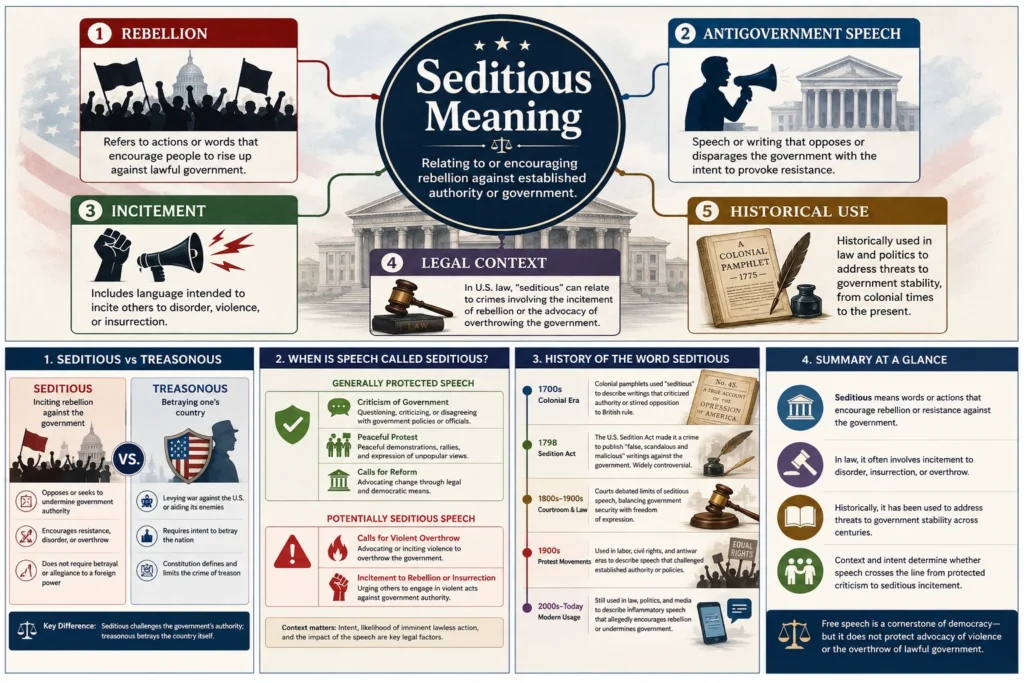
Seditious means encouraging rebellion, resistance, or hostility against a government or established authority. It is usually used in political, legal, and historical contexts to describe speech, writing, actions, or behavior seen as stirring unrest, insurrection, or antigovernment opposition.
If you have come across the word seditious in a news article, courtroom discussion, history book, political debate, or social media conversation, you may be wondering about the seditious meaning and how the term is used in plain English. The word often sounds formal and serious because it is commonly associated with government authority, political conflict, rebellion, public unrest, and accusations of encouraging resistance.
The seditious meaning is connected to actions, speech, or writings that are considered to encourage opposition, rebellion, or resistance against established authority. If you are asking what does seditious mean, the answer depends heavily on context. In legal and historical discussions, the term may refer to conduct or expression viewed as threatening to a government or public order. In everyday conversations, however, it is sometimes used more broadly to describe ideas, messages, protests, or individuals perceived as strongly rebellious or disruptive.
Understanding the seditious definition is important because the word carries legal, political, historical, and emotional significance. The meaning of seditious can change depending on who is using the term, where it appears, and whether it is being discussed in a legal, historical, or general context. Learning to define seditious accurately helps prevent misunderstandings, especially when the word appears in news reports, political discussions, educational materials, or online debates.
In this comprehensive guide, you will learn the complete seditious meaning, its dictionary definition, historical background, legal context, modern usage, and the differences between terms such as seditious, treasonous, rebellious, and subversive. You will also explore real-life examples, conversation scenarios, common misconceptions, and how to understand the word correctly across news, politics, education, and digital discussions.
This guide is designed to provide a clear, balanced, and accurate explanation of the term in natural US English while keeping its historical and legal context in perspective.
Quick Answer Box
| Element | Explanation |
| Word | Seditious |
| Basic Meaning | Encouraging rebellion, resistance, or hostility against a government or authority |
| Common Context | Politics, law, history, journalism, public speech, protest discussions |
| Tone | Serious, formal, often accusatory |
| Usually Describes | Speech, writings, actions, slogans, organizations, publications, or conduct |
| Simple Example | “The government called the pamphlet seditious because it urged people to rise against state authority.” |
| Modern Use | Often seen in legal reporting, political commentary, or historical writing |
| Not the Same As | General criticism of government, ordinary protest, or simply being controversial |
What Does Seditious Mean?
At its core, seditious means promoting rebellion or resistance against a government, state, or lawful authority. It usually describes words, actions, writings, or behavior that are seen as inciting people to oppose or overthrow authority.
A very simple way to understand it is this:
If something is called seditious, it is being described as encouraging people to fight against, undermine, or revolt against the government or ruling authority.
The word is closely connected to the noun sedition.
- Sedition = conduct, speech, writing, or organization that encourages rebellion against authority
- Seditious = the adjective used to describe that conduct, speech, writing, or behavior
Simple Definition in Everyday English
In everyday plain English, seditious can mean:
- trying to stir people up against the government
- encouraging revolt or rebellion
- promoting hostility toward state authority
- pushing people to resist the rule of law in a political sense
- urging people to challenge government control in a dangerous or unlawful way
Short Example
- “The speech was described as seditious because it called for violent resistance against the government.”
In that sentence, seditious does not just mean “angry” or “critical.” It suggests the speech went further and encouraged opposition that could lead to rebellion or insurrection.
Full Definition of Seditious
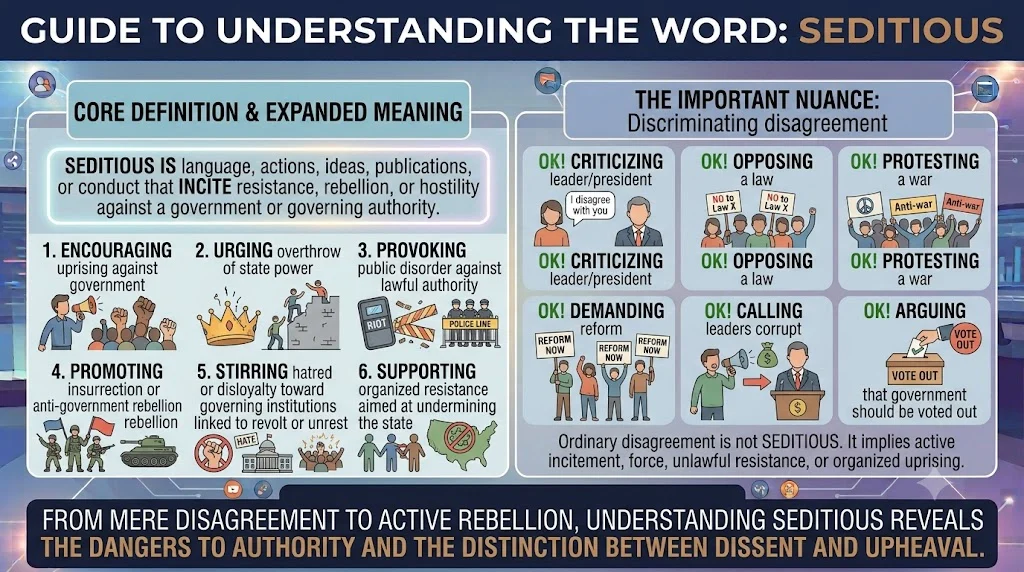
The full meaning of seditious becomes clearer when you break it into its legal, political, and languagebased layers.
Core Definition
Seditious refers to language, actions, ideas, publications, or conduct that incite resistance, rebellion, or hostility against a government or governing authority.
Expanded Meaning
A person, statement, article, chant, or movement may be called seditious if it is seen as doing one or more of the following:
- encouraging people to rise up against the government
- urging the overthrow of state power
- provoking public disorder against lawful authority
- promoting insurrection or antigovernment rebellion
- stirring hatred or disloyalty toward governing institutions in a way linked to revolt or unrest
- supporting organized resistance aimed at undermining the state
The Important Nuance
Not every antigovernment statement is automatically seditious.
That distinction matters.
A person can:
- criticize a president
- oppose a law
- protest a war
- demand reform
- call leaders corrupt
- argue that a government should be voted out
…and none of that automatically makes their speech seditious.
The word generally implies something stronger and more dangerous than ordinary disagreement. It suggests active incitement, rebellion, insurrection, or attempts to destabilize authority, especially through force, unlawful resistance, or organized uprising.
The Origin of the Word Seditious
The word seditious comes from sedition, which has roots in Latin. Historically, it referred to civil disorder, dissension, or attempts to stir up revolt. Over time, English adopted the term for political and legal contexts involving threats to state stability.
Why the Origin Matters
Knowing the origin helps explain why the word still sounds so formal and heavy. It is not casual slang. It belongs to a family of words tied to:
- rebellion
- uprising
- public disorder
- antistate agitation
- insurrectionary rhetoric
- political unrest
That is why you are far more likely to see seditious in:
- court reporting
- constitutional law discussions
- national security commentary
- historical writing
- political analysis
- official accusations
than in casual everyday conversation.
Seditious vs Sedition
People often search for seditious meaning when they are also trying to understand sedition. The two are closely related, but they are not the same part of speech.
| Term | Part of Speech | Meaning |
| Sedition | Noun | Conduct, speech, writing, or activity that encourages rebellion against authority |
| Seditious | Adjective | Describing something as related to sedition or as inciting rebellion |
Example Comparison
- “The government charged the group with sedition.”
- “The government said the group had distributed seditious material.”
In the first sentence, sedition is the offense or act.
In the second, seditious describes the material.
Legal Meaning of Seditious in the United States
In the United States, the word seditious often appears in discussions of sedition, seditious conspiracy, insurrection, national security, and political violence. However, the legal use of the term is narrower and more complex than the casual or rhetorical use.
Important Legal Idea
In legal settings, calling something seditious can imply that it is intended to incite or organize opposition to the government through force, rebellion, or unlawful disruption.
That said, US law strongly protects free speech under the First Amendment. So there is a major difference between:
- protected political speech, even if harsh or offensive
and - speech or conduct that crosses into illegal incitement, conspiracy, or attempts to use force against the government
Why the Word Is Sensitive in US Contexts
In American political and legal discussion, labeling speech as seditious is serious because it can suggest:
- incitement of insurrection
- organized antigovernment violence
- conspiracy against lawful authority
- attempts to obstruct or overthrow government functions by force
Because of constitutional protections, the threshold for actual criminal liability is much higher than simply saying something angry about the government.
Practical US Understanding
In US news and commentary, when someone says a statement or movement is seditious, they often mean it appears to:
- encourage rebellion against government authority
- promote violent antigovernment resistance
- incite unlawful action against the state
- undermine lawful government operations through force or organized revolt
But whether that behavior legally qualifies as sedition or a related offense depends on facts, intent, conduct, and the law.
Is Seditious the Same as Treason?
No. Seditious and treasonous are related ideas, but they are not the same thing.
Basic Difference
- Seditious usually involves inciting rebellion, resistance, or hostility against government authority
- Treasonous usually refers to betraying one’s country, often by aiding enemies or committing acts defined as treason under law
Quick Comparison
| Word | Main Idea | Focus |
| Seditious | Stirring rebellion or antigovernment resistance | Incitement, agitation, insurrectionary behavior |
| Treasonous | Betrayal of one’s country | Loyalty, betrayal, aiding enemies, warrelated or constitutional offense |
Example
- “The pamphlet was called seditious because it urged people to overthrow the government.”
- “The official was accused of treasonous conduct for secretly helping an enemy state.”
So while both words sound severe, seditious is more about rebellion and antigovernment incitement, while treasonous is more about betrayal of the nation.
Is Seditious Always Illegal?
Not automatically in the way people often assume. This is where context matters a lot.
In ordinary language
Someone may call a speech, slogan, article, or protest message seditious simply because they believe it dangerously encourages rebellion.
In law
For conduct to be punished under criminal law, it generally must meet a much more specific standard than simply being radical, angry, or antigovernment.
Key Distinction
There is a difference between:
- criticizing the government
- calling for political change
- supporting civil disobedience
- expressing rage at leaders
and
- encouraging violent revolt
- organizing forceful resistance
- plotting to oppose government authority through unlawful means
- inciting imminent unlawful action
That distinction is one reason the word seditious can be controversial. People sometimes use it rhetorically to condemn speech they dislike, even when the speech may still be legally protected.
Context and Usage of Seditious
The meaning of seditious becomes much easier to grasp when you see where it is commonly used.
Political Context
In politics, seditious is often used to describe speech or actions seen as encouraging people to oppose government authority in a dangerous or revolutionary way.
Examples:
- a speech calling for violent overthrow of the government
- propaganda encouraging armed resistance
- a manifesto urging people to attack state institutions
- an organized campaign to violently block lawful government transfer of power
Example Sentence
- “Opponents called the leader’s remarks seditious, arguing that he was urging supporters to defy the state by force.”
Legal Context
In legal reporting, seditious often appears in discussions about:
- sedition
- seditious conspiracy
- incitement
- insurrection
- antistate violence
- extremist plots against government institutions
Example Sentence
- “Prosecutors argued that the defendants shared seditious plans to use force against federal authority.”
Historical Context
In history, seditious was often used to label:
- revolutionary pamphlets
- anticolonial writings
- dissenting newspapers
- speeches against monarchies or empires
- labor and political organizing seen as threatening by those in power
Example Sentence
- “The colonial authorities banned the newspaper as seditious.”
In historical writing, the word may reflect the perspective of the government in power, not necessarily an objective moral judgment.
Media and Journalism Context
Journalists may use seditious when reporting on allegations involving:
- antigovernment violence
- insurrectionary rhetoric
- extremist organizing
- attempts to obstruct state functions by force
Example:
- “Investigators examined whether the online posts contained seditious rhetoric.”
Everyday Rhetorical Use
Sometimes people use seditious more loosely to describe anything they see as antiestablishment or dangerously rebellious.
For example:
- “That article sounds almost seditious.”
- “His speech was so extreme people called it seditious.”
In these cases, the speaker may not be making a legal claim. They may simply mean the content sounded revolutionary, inflammatory, antigovernment, or destabilizing.
Emotional Meaning and Tone of Seditious
The word seditious has a very strong tone. It is not neutral.
When someone uses it, the emotional message often includes one or more of these ideas:
- dangerous
- disloyal
- rebellious
- destabilizing
- inflammatory
- antigovernment
- threatening to public order
- politically extreme
Tone Summary
| Tone Element | How It Feels |
| Formal | Usually not casual slang |
| Serious | Often tied to law, politics, or conflict |
| Accusatory | Can imply wrongdoing or danger |
| Loaded | Often used to condemn or warn |
| Historical | Frequently heard in history and legal analysis |
Because of that tone, seditious is not a word to use lightly.
RealLife Examples of Seditious in Sentences
Here are some clear examples showing how the word works in real English.
- “The government described the publication as seditious because it urged citizens to take up arms.”
- “His critics said the speech crossed the line from protest into seditious rhetoric.”
- “Colonial authorities imprisoned writers accused of spreading seditious ideas.”
- “The article was controversial, but not every harsh criticism of the state is seditious.”
- “Investigators examined whether the group’s online messages were merely political or openly seditious.”
- “The prosecutor argued that the defendants promoted a seditious plan to disrupt lawful government operations.”
- “The senator condemned the posters as seditious propaganda.”
- “Historians now debate whether those socalled seditious leaflets were actually early demands for democratic reform.”
These examples show that seditious usually appears in contexts involving power, government, resistance, and accusations of incitement.
5 Conversation Examples Using Seditious
Below are realistic dialogue examples so you can see how people might talk about the word in conversation, education, media, and online discussion.
Conversation Example 1: News Discussion
Scenario
Two people are discussing a news headline about antigovernment messaging.
Person A: I saw a headline saying the group published “seditious material.” What does that mean?
Person B: It usually means the material was seen as encouraging rebellion or resistance against the government.
Person A: So like criticism of politicians?
Person B: More serious than that. It usually implies speech that tries to stir up revolt, unrest, or antigovernment action.
Conversation Example 2: History Class
Scenario
A student asks about colonialera writing.
Student: Why were those pamphlets called seditious?
Teacher: Because authorities believed they encouraged people to oppose the ruling government.
Student: Were they illegal?
Teacher: Sometimes they were treated that way, especially if officials thought they could provoke rebellion.
Conversation Example 3: Legal Commentary
Scenario
A person is trying to understand a legal analysis video.
Person A: The commentator said the messages might be seditious.
Person B: That means they may have encouraged rebellion or force against the government.
Person A: So is that automatically a crime?
Person B: Not automatically. It depends on the law, the facts, intent, and whether the speech crossed legal lines.
Conversation Example 4: Social Media Debate
Scenario
Someone sees a heated political post online.
User 1: That thread is wild. People are calling it seditious.
User 2: Probably because it sounds like it’s telling people to attack the government instead of just protest it.
User 1: So it’s not just antigovernment opinions?
User 2: Right. The word suggests rebellion, not just criticism.
Conversation Example 5: Vocabulary Learning
Scenario
A student is studying for an exam.
Student A: I keep forgetting what seditious means.
Student B: Think of it this way: if speech encourages revolt against the government, it could be called seditious.
Student A: So it’s about rebellion?
Student B: Exactly. Rebellion, incitement, or stirring people against authority.
PlatformSpecific Meaning and Usage
The word seditious is not a typical internet slang term like “slay,” “ate,” or “sus.” It is a formal political and legal word. Still, people may encounter it across different digital platforms, especially in discussions about politics, protests, government power, or current events.
X / Twitter
On X, the word seditious often appears in fastmoving political arguments, reactions to speeches, commentary on government actions, or discussions of public unrest.
How It’s Used on X
People may use it to describe:
- speeches seen as encouraging insurrection
- posts calling for violent antigovernment action
- political figures accused of inciting unrest
- leaked messages or manifestos tied to extremist activity
Example
- “That wasn’t just reckless rhetoric. It sounded openly seditious.”
Caution
On X, people also overuse serious terms. Someone may call a statement seditious for dramatic effect even when it is just aggressive political commentary.
On Reddit, the word often shows up in:
- law subreddits
- history threads
- political analysis discussions
- debates about free speech and extremism
- currentevents communities
Common RedditStyle Use
- “Would that actually count as seditious speech, or is it still protected under the First Amendment?”
- “The pamphlet was considered seditious by the government at the time, but historians view it differently now.”
Reddit discussions often focus on the difference between criticism of government and actual incitement to rebellion.
YouTube
On YouTube, you may hear seditious in:
- legal explainers
- documentary videos
- history content
- political commentary
- analysis of trials or investigations
Example
- “In this video, we’ll break down whether the recorded speech could be described as seditious under historical or legal definitions.”
News Websites and Podcasts
This is one of the most common places to see the word today. News outlets may use it in coverage of:
- alleged plots against government institutions
- extremist groups
- antistate violence
- public hearings
- historical anniversaries of rebellions or protest movements
Example
- “The host discussed whether the rhetoric used at the rally was merely inflammatory or potentially seditious.”
TikTok and Instagram
You are less likely to see seditious in casual lifestyle content, but it can still appear in:
- political commentary clips
- history explainers
- legal vocabulary videos
- reaction content about current events
Example
- “Quick vocab breakdown: ‘seditious’ means encouraging rebellion against the government.”
Alternative Meanings or Nearby Interpretations
Strictly speaking, seditious has a specific political meaning tied to rebellion against authority. But in realworld use, people sometimes stretch it. That can create confusion.
Meaning 1: Literal Political Meaning
This is the most accurate meaning:
- encouraging rebellion against the government
- promoting antigovernment uprising or insurrection
- stirring resistance against lawful authority
Meaning 2: Looser Rhetorical Meaning
Some people use seditious more loosely to mean:
- dangerously antigovernment
- revolutionary in a threatening way
- hostile to state authority
- inflammatory political speech
In this looser sense, the speaker may not be making a technical legal claim. They may just be saying, “This sounds extreme and antigovernment.”
Meaning 3: Historical Label Used by Authorities
Historically, governments sometimes called publications, activists, speeches, or movements seditious simply because they challenged power. That does not always mean the material actually encouraged violent rebellion. Sometimes it reflected the perspective of authorities trying to suppress dissent.
That is why context matters so much.
Related Terms and NLP Variations
If you are researching seditious meaning, you may also come across related words and phrases. Some overlap strongly; others only partially overlap.
Synonyms and NearSynonyms
Depending on context, seditious may be related to:
- rebellious
- insurrectionary
- subversive
- incendiary
- antigovernment
- revolutionary
- inflammatory
- mutinous
- disloyal
- insurgent
Important Note on Synonyms
These are not perfect substitutes in every sentence.
For example:
- subversive can mean trying to undermine a system, even quietly
- rebellious can be much broader and less political
- incendiary can simply mean provocative or likely to inflame emotions
- treasonous involves betrayal, not just rebellion
- insurrectionary is often even closer to violent uprising
Related Search Terms People Use
People looking up seditious meaning may also search for:
- seditious definition
- what does seditious mean
- sedition meaning
- seditious in a sentence
- seditious vs treasonous
- seditious conspiracy meaning
- what is a seditious act
- seditious speech meaning
- seditious conduct meaning
- antigovernment rhetoric definition
Seditious vs Similar Words
Understanding what seditious is not can help you use it correctly.
Seditious vs Rebellious
Rebellious is broader. A rebellious teenager can break rules at home. A rebellious artist can reject convention. A rebellious worker can challenge management.
Seditious is narrower and more political. It usually involves opposition to government authority.
Seditious vs Subversive
Subversive means undermining an established system or institution, often from within or indirectly. It does not always involve open revolt.
Seditious is more directly tied to inciting resistance or rebellion against the state.
Seditious vs Incendiary
Incendiary speech is inflammatory and likely to provoke strong reactions. It may anger people or intensify conflict.
Seditious speech goes further by suggesting antigovernment rebellion or resistance.
Seditious vs Treasonous
As noted earlier:
- seditious = inciting rebellion against authority
- treasonous = betraying one’s country, often by aiding enemies or waging war against it
Seditious vs Protest
This is one of the most important distinctions.
Protest can be lawful, peaceful, and protected. People can protest government policies, demand reform, march in the streets, and criticize leaders without being seditious.
Seditious implies something more severe, such as urging rebellion, violent resistance, or overthrow of authority.
Misinterpretations of Seditious
The word gets misunderstood a lot. Here are the most common mistakes.
Misinterpretation 1: “It Just Means Critical of the Government”
Not true.
A person can strongly criticize the government without being seditious. In democratic societies, criticism of government is common and often protected.
Misinterpretation 2: “Any Protest Is Seditious”
Also false.
Peaceful protest, civil advocacy, public organizing, and policy criticism are not automatically seditious. The word implies something more extreme, especially rebellion, violent resistance, or antigovernment incitement.
Misinterpretation 3: “Seditious Always Means Illegal”
Not necessarily in casual use.
People may use the word rhetorically or historically without making a legal judgment. Whether something is criminal is a separate legal question.
Misinterpretation 4: “It Means the Same as Treason”
No. The terms overlap in seriousness, but they are different in meaning and legal history.
Misinterpretation 5: “It’s Just a Fancy Word for Angry”
Definitely not.
Someone can be furious at a government, post harsh criticism, or use strong language without saying anything seditious.
When Not to Use the Word Seditious
Because the word is heavy and politically loaded, it should not be used casually for every form of disagreement or rebellion.
Avoid using seditious when you only mean:
- unpopular
- critical
- controversial
- rebellious in a nonpolitical sense
- antiestablishment in a vague cultural way
- emotionally charged
- rude or offensive
Bad Example
- “My coworker’s email about the office dress code was seditious.”
That sounds wrong unless your office somehow operates as a sovereign state. The word is too politically specific for ordinary workplace complaints.
Better Alternatives in Casual Contexts
If you do not mean antigovernment rebellion, consider words like:
- defiant
- inflammatory
- provocative
- rebellious
- subversive
- radical
- confrontational
- controversial
How to Respond If Someone Uses the Word Seditious
If someone uses seditious in a conversation, article, debate, or social media post, the best response depends on what they mean.
If They Mean It as a Vocabulary Question
You can answer simply:
- “Seditious means encouraging rebellion or resistance against the government.”
- “It usually refers to speech or actions seen as stirring revolt against authority.”
If They Use It in a Political Debate
A good followup question is:
- “Do you mean it was antigovernment, or do you mean it actually encouraged rebellion or violence?”
That helps clarify whether they are using the word accurately or just dramatically.
If They Are Talking About Law
A careful response might be:
- “That sounds like an allegation of antigovernment incitement, but whether it is legally seditious would depend on the facts and the law.”
If They Use It Too Loosely
You can gently correct the framing:
- “Seditious is a strong word. Criticizing the government isn’t the same as encouraging rebellion against it.”
Usage Tips: How to Use Seditious Correctly
Here are practical rules for using the word well.
Tip 1: Reserve It for GovernmentRelated Contexts
Use seditious when the issue involves:
- the state
- government power
- public authority
- rebellion
- insurrection
- antigovernment incitement
Tip 2: Make Sure the Behavior Goes Beyond Ordinary Criticism
Before using the word, ask:
- Is this actually about rebellion or resistance against government authority?
- Is there incitement, agitation, organized opposition, or calls for unlawful force?
- Or is it simply criticism, protest, or dissent?
Tip 3: Recognize the Weight of the Word
Calling speech seditious is not casual. It can imply:
- dangerous antigovernment intent
- incitement to revolt
- extremist conduct
- serious legal or moral accusations
Tip 4: Use It Carefully in Historical Writing
In history, the label seditious may reflect the viewpoint of those in power. A “seditious” pamphlet in one era might later be seen as a democratic reform document or anticolonial resistance text.
Tip 5: Do Not Confuse It With “Edgy”
A shocking or radical opinion is not automatically seditious. The word should stay tied to governmental authority and rebellion.
RealWorld Scenarios: Is It Seditious or Not?
These quick examples can help sharpen the distinction.
Scenario 1: “Vote the government out next election.”
Seditious? No.
That is ordinary political participation.
Scenario 2: “This law is unjust and should be repealed.”
Seditious? No.
That is criticism and policy advocacy.
Scenario 3: “Citizens should march peacefully and demand reform.”
Seditious? Not by itself.
That is protest language, not necessarily rebellion.
Scenario 4: “We must storm government buildings and remove officials by force.”
Potentially seditious? Yes, that language could be described that way because it promotes forceful antigovernment action.
Scenario 5: “The regime must fall, and we should arm ourselves to overthrow it.”
Potentially seditious? Yes.
This directly suggests rebellion or violent overthrow.
Scenario 6: “The government lies constantly.”
Seditious? No, not by itself.
Harsh criticism alone is not enough.
Why People Search for “Seditious Meaning”
Search intent around this term is usually a mix of several needs.
Primary Intent: Definition
Most users simply want to know:
- What does seditious mean?
- Is it about rebellion?
- Is it a legal term?
Secondary Intent: News Understanding
Many people encounter the word in:
- political headlines
- trial coverage
- congressional or parliamentary reporting
- discussions of unrest or extremist movements
They want to understand what the accusation actually implies.
Hidden Intent: Is It Illegal or Just Strong Language?
A large number of users also want to know:
- Is “seditious” a legal accusation or just a dramatic insult?
- Does it mean treason?
- Can criticism of the government be called seditious?
That is why context is essential.
FAQs
1) What does seditious mean in simple words?
Seditious means encouraging rebellion, revolt, or resistance against a government or lawful authority. It usually describes speech, writing, or actions seen as stirring antigovernment unrest.
2) Is seditious a bad word?
It is not a profanity, but it is a very serious and negative word. It usually carries an accusation that something is dangerous, rebellious, or antigovernment in a threatening way.
3) What is the difference between sedition and seditious?
Sedition is the noun for conduct or speech that promotes rebellion against authority. Seditious is the adjective used to describe that conduct, speech, or behavior.
4) Does seditious mean treason?
No. They are related but different. Seditious usually refers to inciting rebellion against the government, while treason refers to betraying one’s country, often by aiding enemies or waging war against the state.
5) Can criticism of the government be called seditious?
Not automatically. Criticism, protest, satire, and calls for reform are not inherently seditious. The word usually implies something more severe, such as encouraging rebellion or violent resistance.
6) What does seditious speech mean?
Seditious speech refers to speech alleged to encourage rebellion, resistance, or hostility against the government, especially in a way that may incite unrest, insurrection, or unlawful opposition to authority.
7) What does seditious mean in history?
In history, seditious often described pamphlets, speeches, writings, or movements seen by authorities as threatening to the political order. Sometimes the label reflected a government’s attempt to suppress dissent.
8) Is a protest seditious?
Not by default. Peaceful protest and criticism of public policy are not the same as sedition. A protest would only be described as seditious if it involved inciting rebellion or violent antigovernment action.
9) What are some synonyms for seditious?
Possible related words include rebellious, insurrectionary, subversive, antigovernment, incendiary, revolutionary, and mutinous. But each has slightly different shades of meaning.
10) How do you use seditious in a sentence?
Example: “The authorities claimed the article was seditious because it encouraged citizens to rise up against the state.”
Conclusion
The simplest and most accurate way to understand seditious meaning is this:
Seditious describes speech, writing, actions, or behavior that encourage rebellion, revolt, or resistance against a government or lawful authority.
It is a serious word most often used in:
- politics
- law
- history
- journalism
- public debate about antigovernment violence or unrest
The term does not simply mean “critical,” “controversial,” or “angry.” A statement can attack government policy, condemn leaders, or demand reform without being seditious. The word usually implies something stronger: incitement, rebellion, insurrectionary rhetoric, or organized resistance against authority.
If you remember one thing, make it this:
Seditious = encouraging people to turn against the government in a rebellious or insurrectionary way, not just disagreeing with it.
That distinction is what makes the word so important, so politically loaded, and so often misunderstood.

Justin Powell is a writer at GramBrix.com who focuses on grammar, clarity and effective communication, helping readers strengthen their language skills.