
Last Updated on July 5, 2026
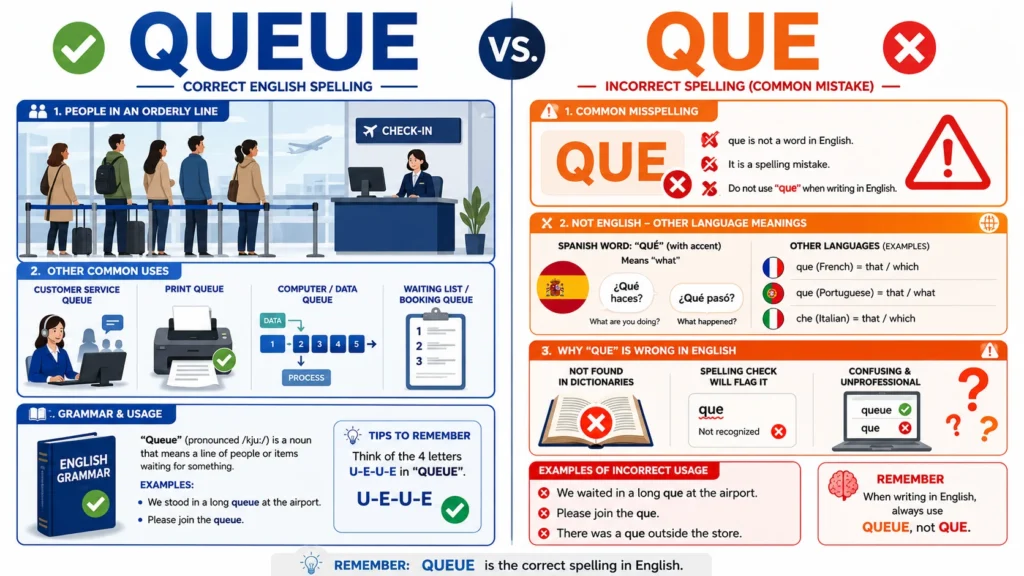
Queue is the correct English word used to describe a line of people, vehicles, tasks, or data waiting for their turn. Que is usually a misspelling of queue in English, although it can be a valid word in Spanish, Portuguese, and some other languages. If you are writing in English and mean a waiting line, use queue, not que.
Many English learners and native speakers alike get confused by the words queue and que. At first glance, they seem similar. In fact, many people accidentally type que when they mean queue because the spelling of queue looks unusual.
The confusion becomes even more common in texting, online chats, customer service messages, and technical fields such as computing. You may see phrases like “join the que” or “wait in the que.” While these phrases are common mistakes, they are not considered correct English.
Understanding the difference between queue or que helps improve your writing and communication. Whether you are writing an email, a school assignment, website content, software documentation, or a social media post, using the correct word creates a professional impression.
This guide explains everything you need to know about queue or que, including definitions, examples, common mistakes, regional usage, exercises, FAQs, and practical tips for remembering the difference.
Quick Answer
| Word | Meaning | Correct in English? |
|---|---|---|
| Queue | A line of people, vehicles, tasks, or data waiting for service | Yes |
| Que | Usually a misspelling of queue in English; a valid word in some other languages | No (for “line”) |
Simple Rule
If you mean:
- A waiting line
- A sequence of tasks
- A list of jobs waiting to be processed
Use queue.
If you write que when you mean a line, it is considered a spelling mistake in English.
What Does Queue Mean?
The word queue refers to something waiting in order.
It can be a noun or a verb.
Queue as a Noun
A queue is a line of people or things waiting their turn.
Examples:
- There was a long queue outside the store.
- We joined the queue for movie tickets.
- The airport security queue moved slowly.
Queue as a Verb
To queue means to form or join a line.
Examples:
- Customers queued outside the stadium.
- People queued for hours to buy concert tickets.
- Drivers queued at the toll booth.
Queue in Computing
In technology, a queue is a structure where items are processed in the order they arrive.
Examples:
- Print queue
- Task queue
- Message queue
- Job queue
A simple rule is:
First In, First Out (FIFO)
The first item added is usually the first item removed.
What Does Que Mean?
The word que has different meanings in languages other than English.
In Spanish
“Que” often means:
- That
- What
- Which
Examples:
- ¿Qué haces? (What are you doing?)
- Creo que sí. (I think that yes.)
In Portuguese
“Que” may mean:
- That
- Which
- What
In English
When someone writes:
- “Wait in the que.”
- “The que is long.”
they almost always mean queue.
Therefore, in English writing, que is typically considered a spelling error when referring to a waiting line.
Why Is Queue So Difficult to Spell?
Many people struggle with the spelling of queue because it contains five letters but sounds almost like the single letter “Q.”
The pronunciation is:
/kjuː/
The spelling pattern is unusual:
Q + U + E + U + E
Many writers accidentally remove letters and write:
- Que
- Qeue
- Queu
- Quewe
The correct spelling remains:
Queue
Easy Memory Trick
Think of the word this way:
The letter Q is followed by four silent letters waiting their turn.
Just like people waiting in a queue.
Queue or Que Comparison Table
| Feature | Queue | Que |
|---|---|---|
| English word for a waiting line | Yes | No |
| Correct English spelling | Yes | No |
| Used in computing | Yes | No |
| Used in Spanish | No | Yes |
| Used in Portuguese | No | Yes |
| Common typo | No | Yes |
| Accepted in formal English | Yes | No |
History and Origin of Queue
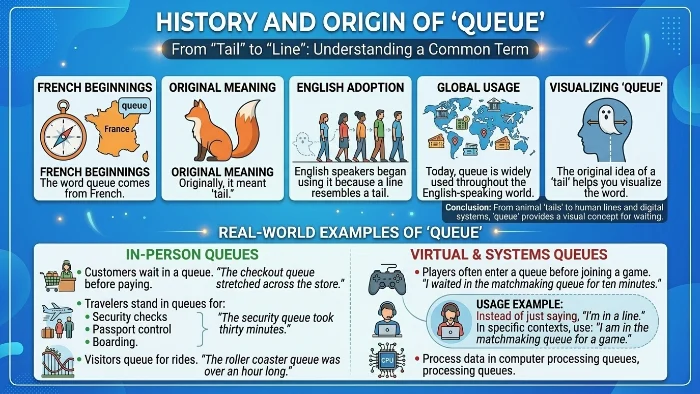
The word queue comes from French.
Originally, it meant “tail.”
Over time, English speakers began using it to describe a line of people because a line resembles a tail extending behind something.
Today, queue is widely used throughout the English-speaking world.
Examples include:
- Bank queues
- Ticket queues
- Airport queues
- Computer processing queues
The original idea of a “tail” can still help you visualize the word.
Real World Examples of Queue
At a Grocery Store
Customers wait in a queue before paying.
Example:
- The checkout queue stretched across the store.
At an Airport
Travelers stand in queues for:
- Security checks
- Passport control
- Boarding
Example:
- The security queue took thirty minutes.
At a Theme Park
Visitors queue for rides.
Example:
- The roller coaster queue was over an hour long.
Online Gaming
Players often enter a queue before joining a game.
Example:
- I waited in the matchmaking queue for ten minutes.
Customer Service
Support requests are placed in a queue.
Example:
- Your ticket is currently in the support queue.
Queue in Technology and Computing
One of the most important uses of queue appears in computer science.
A queue stores data in a specific order.
How a Queue Works
Imagine people waiting for a bus.
The first person in line boards first.
The same principle applies to data queues.
Common Types of Queues
| Queue Type | Purpose |
|---|---|
| Print Queue | Holds print jobs |
| Message Queue | Stores messages between systems |
| Task Queue | Organizes tasks |
| Network Queue | Handles network traffic |
| Job Queue | Manages scheduled work |
FIFO Principle
FIFO means:
First In, First Out
Example:
- Task A arrives.
- Task B arrives.
- Task C arrives.
Processing order:
- Task A
- Task B
- Task C
This is the basic queue model.
Regional Usage Around the World
British English
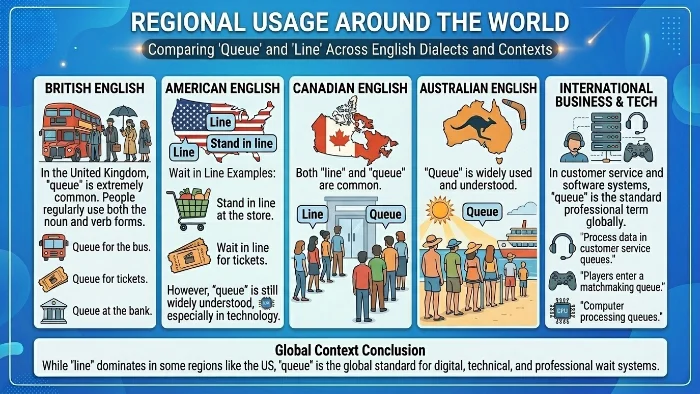
In the United Kingdom, queue is extremely common.
Examples:
- Queue for the bus.
- Queue for tickets.
- Queue at the bank.
People regularly use both the noun and verb forms.
American English
Americans often use:
- Line
- Stand in line
Examples:
- Stand in line at the store.
- Wait in line for tickets.
However, queue is still widely understood, especially in technology.
Canadian English
Both line and queue are common.
Australian English
Queue is widely used and understood.
International Business
In customer service and software systems, queue is the standard professional term globally.
Advantages and Disadvantages of Using Queue
Advantages
Clear Meaning
The word clearly describes waiting in order.
International Recognition
Most English speakers understand it.
Technical Standard
Queue is the accepted term in computing.
Professional Writing
Using queue demonstrates correct spelling and grammar.
Disadvantages
Difficult Spelling
Many people spell it incorrectly.
Pronunciation Confusion
The spelling and pronunciation differ significantly.
Regional Preference Differences
Some regions prefer “line” in everyday speech.
Common Mistakes with Queue and Que
Mistake 1
Incorrect:
- Please wait in the que.
Correct:
- Please wait in the queue.
Mistake 2
Incorrect:
- The que is very long today.
Correct:
- The queue is very long today.
Mistake 3
Incorrect:
- Join the customer service que.
Correct:
- Join the customer service queue.
Mistake 4
Incorrect:
- My print que is full.
Correct:
- My print queue is full.
Mistake 5
Incorrect:
- We qued outside the stadium.
Correct:
- We queued outside the stadium.
How to Remember Queue Instead of Que
Several memory tricks can help.
Think About Waiting Letters
In the word:
Queue
the extra letters are lined up behind the Q.
Just like people standing in a queue.
Remember Technology
Common phrases include:
- Print queue
- Download queue
- Message queue
You rarely see professional software using “que.”
Use Spell Check
Modern writing tools quickly identify “que” when “queue” is intended.
Related Words and Comparisons
Queue vs Line
| Queue | Line |
|---|---|
| More common in British English | More common in American English |
| Used in computing | Rare in computing |
| Formal and technical | Everyday speech |
Example:
- Join the queue.
- Stand in line.
Both may describe the same situation.
Queue vs Cue
This is another common confusion.
| Queue | Cue |
|---|---|
| Waiting line | Signal or prompt |
| Queue for tickets | Cue the music |
Examples:
- We waited in a queue.
- The actor entered on cue.
Queue vs Tail
The original meaning of queue was tail.
Today they are usually different words.
Examples:
- The dog wagged its tail.
- Customers formed a queue.
Queue vs List
A list is simply a collection of items.
A queue is ordered based on waiting sequence.
Examples:
- Shopping list
- Print queue
Queue in Business and Customer Service
Businesses use queues every day.
Examples include:
- Call center queues
- Customer support queues
- Service desk queues
- Online booking queues
Benefits include:
- Fair service
- Better organization
- Reduced confusion
- Efficient operations
Many companies use queue management systems to improve customer experience.
Queue in Everyday Communication
You may encounter queue-related expressions such as:
- Join the queue.
- Move to the front of the queue.
- Queue up.
- Virtual queue.
- Waiting queue.
Examples:
- We joined the queue early.
- Customers queued outside the store.
- The virtual queue opened at noon.
These expressions are common in daily English.
Practice Exercises
Exercise 1: Choose the Correct Word
- Please join the _____.
- The print _____ is full.
- We waited in a long _____.
- Customers _____ outside the shop.
- The support _____ contains fifty requests.
Answers
- Queue
- Queue
- Queue
- Queued
- Queue
Exercise 2: Correct the Mistakes
Find and fix the errors.
- The que moved slowly.
- We joined the airport que.
- My printer que is stuck.
- Customers are waiting in the que.
- The service que is full.
Answers
- The queue moved slowly.
- We joined the airport queue.
- My printer queue is stuck.
- Customers are waiting in the queue.
- The service queue is full.
Exercise 3: Queue or Cue?
Choose the correct word.
- The actor entered on _____.
- The ticket _____ was long.
- The print _____ needs attention.
- The teacher gave a _____.
- We joined the _____.
Answers
- Cue
- Queue
- Queue
- Cue
- Queue
Advanced Understanding of Queue
Physical Queues
These are real-world lines.
Examples:
- Banks
- Airports
- Restaurants
- Ticket counters
Virtual Queues
These exist online.
Examples:
- Website waiting rooms
- Online ticket sales
- Gaming servers
- Customer support systems
Priority Queues
Some systems allow important items to move ahead.
Examples:
- Emergency patients in hospitals
- High-priority computer processes
- VIP customer service systems
Priority queues are common in advanced computing and business operations.
FAQs
Is queue or que correct?
Queue is correct when referring to a waiting line, sequence, or ordered list. Que is usually a misspelling in English.
Why do people write que instead of queue?
People often simplify the spelling because queue contains several silent letters and appears unusual.
Is que a real word?
Yes. It is a real word in languages such as Spanish and Portuguese. However, it does not mean a waiting line in English.
Can queue be used as a verb?
Yes. You can say people queued outside a store or queue up for tickets.
What is a queue in computer science?
A queue is a data structure that follows the First In, First Out principle, where the earliest item is processed first.
Is queue used in American English?
Yes. Americans understand queue, although they often use the word “line” in everyday conversation.
What is the difference between queue and cue?
A queue is a waiting line. A cue is a signal, prompt, or indication to act.
What does queue up mean?
Queue up means to form a line or wait in an organized order.
How do I remember the spelling of queue?
Remember that the extra letters stand behind the Q like people waiting in a queue.
Should I use queue or que in professional writing?
Always use queue when referring to a waiting line, customer queue, print queue, or task queue.
Conclusion
The debate over queue or que is actually quite simple once you understand the meanings. Queue is the correct English word for a line of people, vehicles, tasks, or data waiting their turn. It is used in everyday situations, customer service environments, business operations, and computer science. Que, on the other hand, is generally a spelling mistake when you intend to write queue, although it remains a legitimate word in languages such as Spanish and Portuguese.
The unusual spelling of queue causes many writers to make errors, but a few memory tricks can help. Think of the extra letters standing behind the Q like people waiting in line. Also remember common phrases such as print queue, support queue, and ticket queue, all of which use the standard spelling.
For professional, academic, and business writing, always choose queue when referring to a waiting line or ordered sequence. Correct spelling improves clarity, credibility, and communication. When in doubt, remember this simple rule: if something is waiting its turn, it belongs in a queue, not a que.

Victoria Lane is a grammar-focused writer at GramBrix.com, passionate about helping readers master the rules of language. She provides clear explanations and practical examples that make writing more accurate, polished and confident.