Last Updated on July 9, 2026
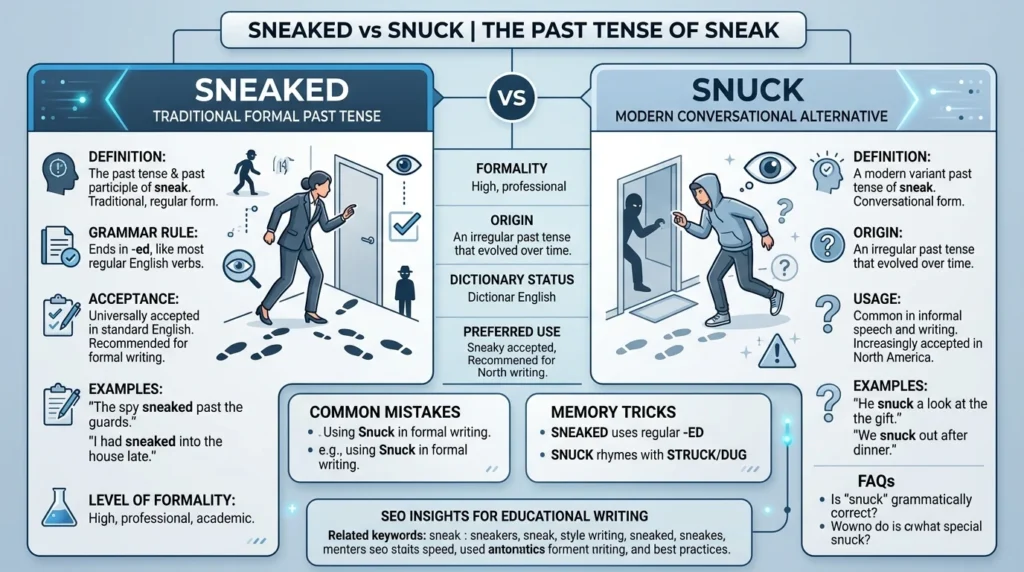
Both sneaked and snuck are correct past tense forms of the verb “sneak.” Traditionally, sneaked was the original and standard past tense, while snuck emerged later in North American English and became widely accepted. Today, both forms are recognized by major dictionaries, although sneaked is often preferred in formal writing and snuck is more common in casual conversation.
The debate over sneaked or snuck is one of the most common grammar questions in English.
Many writers wonder whether they should write:
- He sneaked into the room.
- He snuck into the room.
The surprising answer is that both are correct.
However, there are differences in:
- History
- Regional usage
- Formality
- Writing style
- Reader expectations
Understanding these differences helps improve your writing and ensures you choose the right word for your audience.
This guide explains:
- The meaning of sneak
- The difference between sneaked and snuck
- Grammar rules
- Examples
- Common mistakes
- SEO insights
- FAQs
Quick Answer
| Word | Correct? | Common Usage |
|---|---|---|
| Sneaked | Yes | Traditional and formal |
| Snuck | Yes | Informal and conversational |
| Both | Yes | Accepted modern English |
Simple Summary
- Sneaked is the original past tense.
- Snuck developed later and became widely accepted.
- Both are grammatically correct today.
What Does Sneak Mean?
Definition
The verb sneak means to move quietly, secretly, or without being noticed.
Common Meanings
Sneak can mean:
- Move secretly
- Enter unnoticed
- Leave quietly
- Act covertly
Examples
- She tried to sneak out early.
- The cat sneaked into the house.
- He snuck into the theater.
Everyday Usage
The word frequently appears in:
- Conversations
- Literature
- News articles
- Entertainment media
What Does Sneaked Mean?
Definition
Sneaked is the traditional past tense and past participle of sneak.
Historical Usage
Sneaked was the only accepted form for centuries.
Examples
- She sneaked out after midnight.
- The child sneaked a cookie before dinner.
- He had sneaked away quietly.
Formal Acceptance
Sneaked remains highly respected in academic and professional writing.
What Does Snuck Mean?
Definition
Snuck is an alternative past tense form of sneak.
Historical Development
Snuck became popular in American English during the late 19th century.
Examples
- He snuck into the building.
- She snuck a look at the answers.
- They had snuck away unnoticed.
Modern Popularity
Snuck is extremely common in spoken English.
Main Difference Between Sneaked and Snuck
Meaning
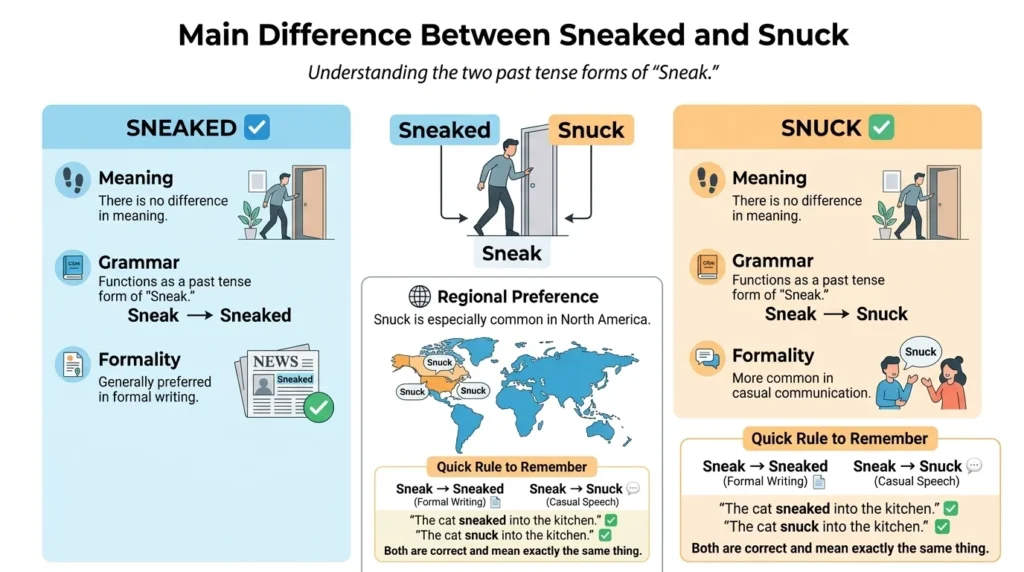
There is no difference in meaning.
Grammar
Both function as past tense forms.
Formality
Sneaked
Generally preferred in formal writing.
Snuck
More common in casual communication.
Regional Preference
Snuck is especially common in North America.
Comparison Table
| Feature | Sneaked | Snuck |
|---|---|---|
| Meaning | Same | Same |
| Past Tense | Yes | Yes |
| Formal Writing | Preferred | Less Common |
| Casual Speech | Common | Very Common |
| Historical Form | Original | Newer Form |
Is Snuck a Real Word?
Yes
Modern dictionaries recognize snuck as a correct word.
Historical Debate
Some traditional grammarians once criticized it.
Current Acceptance
Today, major style guides generally accept both forms.
Everyday Usage
Snuck is now firmly established in English.
Why Did Snuck Become Popular?
Pattern Matching
English speakers often formed snuck by analogy with words like:
- Stick → Stuck
- Strike → Struck
Natural Language Change
Languages evolve through everyday usage.
American English Influence
Snuck gained popularity in the United States before spreading more widely.
Modern Acceptance
Frequent usage eventually made it standard.
How to Use Sneaked Correctly
Formal Writing
Examples:
- The suspect sneaked into the building.
- She sneaked away quietly.
Academic Writing
Examples:
- The researchers sneaked references into the discussion.
Professional Communication
Examples:
- Unauthorized personnel sneaked into the area.
Journalism
Many editors still prefer sneaked.
How to Use Snuck Correctly
Conversation
Examples:
- He snuck out after bedtime.
- She snuck into the movie theater.
Fiction Writing
Examples:
- The spy snuck through the hallway.
Informal Communication
Examples:
- I snuck a snack before dinner.
Modern Media
Snuck frequently appears in television and movies.
Sneaked vs Snuck in American English
Modern Usage
Snuck is extremely common.
Everyday Conversation
Many Americans naturally choose snuck.
Publishing
Both forms are accepted.
Reader Expectations
Most readers view both as correct.
Sneaked vs Snuck in British English
Traditional Preference
British English historically favored sneaked.
Modern Changes
Snuck is becoming more common.
Formal Contexts
Sneaked often remains preferred.
Everyday Speech
Both forms may appear.
Common Examples of Sneaked
School
- He sneaked into the classroom late.
Home
- The dog sneaked onto the couch.
Work
- She sneaked out early.
Travel
- They sneaked through the side entrance.
Common Examples of Snuck
Entertainment
- He snuck backstage.
Family Life
- The child snuck a cookie.
Sports
- The player snuck behind the defense.
Friendship
- She snuck into the surprise party.
Common Mistakes People Make
Thinking Snuck Is Wrong
Modern dictionaries recognize it.
Assuming Sneaked Is Outdated
Sneaked remains widely used.
Mixing Formal and Casual Styles
Choose one form consistently.
Believing There Is a Meaning Difference
Both words mean exactly the same thing.
Which Word Is More Common?
Spoken English
Snuck often dominates conversation.
Formal Writing
Sneaked is frequently preferred.
American Usage
Snuck is extremely popular.
Global English
Both forms are widely understood.
Which Version Is Better for SEO?
Search Intent
Users generally want grammar clarification.
Content Strategy
Include both forms throughout the article.
Featured Snippet Potential
Simple explanations rank well.
SEO Recommendation
Target sneaked or snuck and explain that both are correct while highlighting usage differences.
How to Remember the Difference
The Formality Trick
Sneaked = More traditional
Snuck = More conversational
The History Trick
Sneaked came first.
Snuck developed later.
Easy Formula
Formal = Sneaked
Casual = Snuck
Memory Shortcut
If you’re writing professionally, choose sneaked. If you’re writing casually, either form works.
Related Word Comparisons
Dreamed or Dreamt
Another past tense variation.
Learned or Learnt
American vs British preference.
Spelled or Spelt
Common grammar comparison.
Sneaked or Snuck
One of the most searched verb-form debates in English.
Exercises With Answers
Exercise 1
Which form is the original past tense?
Answer: Sneaked
Exercise 2
Which form became popular later?
Answer: Snuck
Exercise 3
Complete the sentence:
He _____ into the room unnoticed.
Answer: Sneaked or Snuck
Exercise 4
Are both forms accepted today?
Answer: Yes
Exercise 5
Which form is often preferred in formal writing?
Answer: Sneaked
FAQs
Is it sneaked or snuck?
Both are correct past tense forms of sneak.
Which word is more formal?
Sneaked is generally considered more formal.
Is snuck a real word?
Yes. Modern dictionaries recognize it as standard English.
Which form came first?
Sneaked is the original historical form.
Do sneaked and snuck mean different things?
No. Their meanings are identical.
Which word is more common in conversation?
Snuck is often more common in everyday speech.
Can I use snuck in professional writing?
Usually yes, although some editors prefer sneaked.
Which form is more common in American English?
Snuck.
Which form is more common in formal documents?
Sneaked.
Which version is better for SEO?
Use both forms naturally because users search for both.
Conclusion
The answer to sneaked or snuck is simple:
Both forms are correct.
Key takeaways include:
- Sneaked is the original and more traditional form.
- Snuck emerged later and gained widespread acceptance.
- Both words mean exactly the same thing.
- Sneaked is often preferred in formal writing.
- Snuck is extremely common in everyday conversation.
Remember this simple rule:
Sneaked = Traditional and Formal
Snuck = Modern and Conversational
Using either form correctly will make your writing clear, natural, and grammatically accurate in 2026 and beyond.

Kevin Brooks is a grammar specialist at GramBrix.com, dedicated to helping readers understand language rules with clarity and confidence. He simplifies complex grammar concepts through practical examples and easy explanations.