Last Updated on July 12, 2026
Cadence means the rhythm, flow, or pattern of movement, sound, speech, or activity. In everyday English, it often describes the natural beat of someone’s voice or a repeated pace. In music, it can mean a melodic or harmonic ending. In fitness and cycling, it usually refers to pedaling speed.
If you’ve seen the word cadence and wondered what it actually means, you’re not alone. It’s one of those English words that shows up in very different places—music lessons, public speaking, poetry, cycling apps, military drills, business meetings, and even software or marketing conversations.
So what does cadence meaning really come down to?
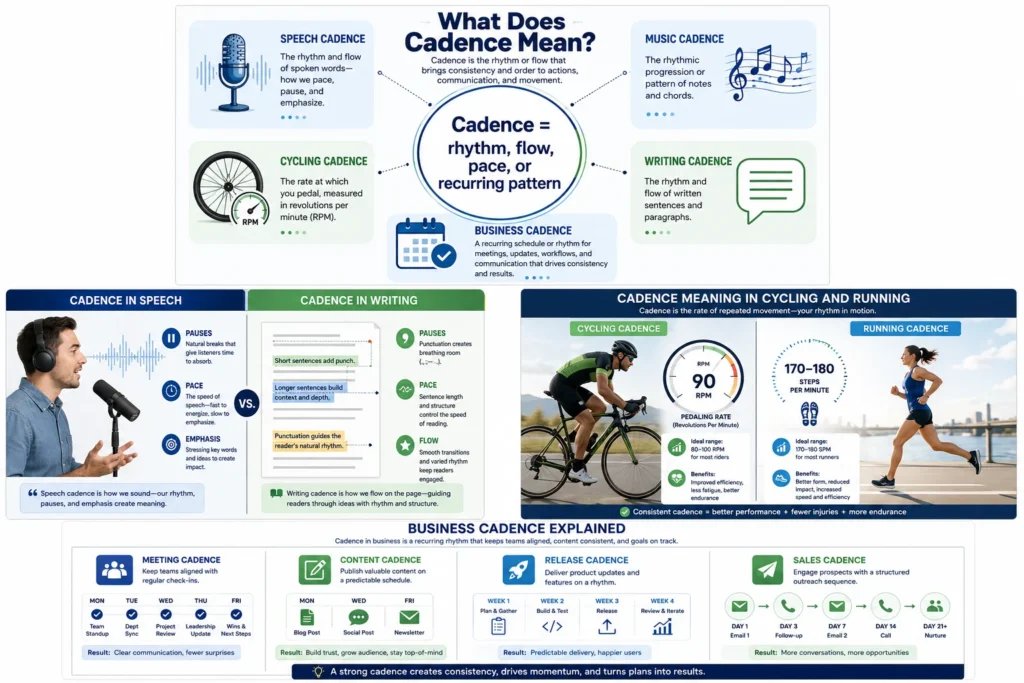
At its core, cadence is about rhythm, flow, pace, and recurring pattern. It can describe the way someone speaks, the beat of a song, the speed of pedaling on a bike, the timing of a team’s meetings, or the pattern of a process that repeats over time.
In this guide, you’ll get a complete, plainEnglish breakdown of the word cadence, including:
- its main meaning in everyday English
- how it’s used in music, speech, writing, and sports
- reallife examples and chatstyle conversations
- alternative meanings depending on context
- related words and common misunderstandings
- how to know what someone means when they say “cadence”
If you want a quick answer and then a deeper explanation, this article covers both.
Quick Answer Box
| Topic | Answer |
| Word | Cadence |
| Core meaning | A rhythm, flow, pace, or repeated pattern |
| Common contexts | Speech, music, poetry, cycling, running, military marching, business workflows |
| Simple definition | The natural beat or timing of something, especially speech, movement, or sound |
| In speech | The rise and fall of a person’s voice |
| In music | A phrase ending or harmonic resolution |
| In cycling | The rate of pedaling, often measured in RPM |
| In business | A recurring schedule or operating rhythm, such as a weekly meeting cadence |
| Tone of the word | Neutral, professional, descriptive |
| Example sentence | “She speaks with a calm cadence that makes her easy to listen to.” |
What Does Cadence Mean?
Cadence generally means a measured rhythm, flow, pace, or recurring pattern. The exact meaning changes a bit depending on the situation, but the central idea stays the same: something moves, sounds, or happens in a regular or recognizable rhythm.
Here’s the simplest way to think about it:
- If it’s about speech, cadence is the pattern and musicality of someone’s voice.
- If it’s about music, cadence is often the way a phrase ends or resolves.
- If it’s about movement, cadence can mean the regular pace of steps, marching, or pedaling.
- If it’s about work or communication, cadence can mean a repeating schedule or rhythm, like a weekly update cadence or monthly content cadence.
In plain US English, cadence is a versatile word that often sounds a little more polished or precise than words like rhythm, pace, or flow. People use it when they want to describe not just speed, but the pattern and feel of how something unfolds.
Full Definition of Cadence
A fuller definition of cadence is:
Cadence is the rhythmic flow, repeated timing, or patterned movement of speech, sound, action, or events. It can also refer to a musical conclusion or a recurring operational schedule.
That definition includes the most common ways the word is used today. To make it easier, it helps to break cadence into a few major meanings.
Cadence as rhythm or flow
This is the broadest meaning. Cadence can describe:
- the rhythm of someone’s speaking voice
- the flow of a poem or sentence
- the beat or pattern of footsteps
- the pace of repetitive movement
- the recurring rhythm of a task or process
Example:
- “The cadence of the waves made the scene feel calm.”
- “His presentation had a confident cadence.”
Cadence as an ending in music
In music theory, cadence has a more technical meaning. It refers to a musical phrase ending or harmonic resolution—basically the way a section of music feels like it pauses, lands, or concludes.
Example:
- “The song ends with a strong cadence.”
- “That chord progression creates an authentic cadence.”
Cadence as pedaling speed in cycling
In cycling and spin classes, cadence often means how fast you pedal, usually measured in RPM (revolutions per minute).
Example:
- “Try to keep your cadence around 90 RPM.”
- “My cadence dropped on the hill climb.”
Cadence as recurring timing in work or business
In professional settings, cadence often means a repeating schedule or routine.
Example:
- “We have a weekly reporting cadence.”
- “The content team built a monthly publishing cadence.”
This usage has become very common in marketing, sales, product, project management, and software teams.
The Core Idea Behind Cadence
Even though cadence appears in different industries, the core idea is surprisingly consistent:
Cadence = the rhythm and timing pattern of something.
That “something” might be:
- a voice
- a song
- a poem
- footsteps
- a bike pedal stroke
- a team meeting schedule
- a publishing routine
- a workout pattern
So when you see the word, ask yourself:
What is moving, sounding, or repeating here?
That question usually reveals the intended meaning.
Context and Usage of Cadence
The word cadence is highly contextdriven. It’s not slang, and it’s not an acronym. It’s a standard English noun used across creative, athletic, and professional settings. The surrounding words usually tell you exactly what kind of cadence someone means.
Cadence in everyday speech
In everyday English, cadence often refers to how someone sounds when they talk. This includes:
- rhythm
- pacing
- pauses
- emphasis
- rise and fall of tone
Example:
- “I like the cadence of her voice.”
- “The speaker’s cadence kept the audience engaged.”
This usage often overlaps with words like:
- tone
- rhythm
- delivery
- flow
- intonation
But cadence is a little more specific because it focuses on the pattern and pacing of the sound.
Cadence in writing and reading
Writers, editors, teachers, and readers may use cadence to describe the sound quality of language. A sentence can have a strong cadence if it flows smoothly and has a pleasing rhythm when spoken aloud.
Example:
- “That paragraph has a beautiful cadence.”
- “The dialogue feels natural because the cadence sounds realistic.”
In poetry, cadence matters even more because the rhythm of language is part of the effect. But prose can also have cadence, especially in speeches, essays, storytelling, and persuasive writing.
Cadence in movement
Cadence can also refer to a repeated pattern of physical movement:
- walking cadence
- running cadence
- marching cadence
- rowing cadence
- cycling cadence
Example:
- “He settled into a steady cadence on the trail.”
- “The marching cadence kept the group in sync.”
Cadence in structured routines
In work settings, cadence is often used to describe recurring operational timing:
- weekly meeting cadence
- monthly newsletter cadence
- quarterly review cadence
- release cadence in software
- outreach cadence in sales
Example:
- “We need a better cadence for client followups.”
- “The team changed its sprint cadence from two weeks to one.”
This use has become common because it sounds more precise than just saying “schedule.” A cadence implies not only timing, but also repeatability and consistency.
Cadence Meaning in Everyday English
In everyday conversation, the most common meaning of cadence is:
the natural rhythm or flow of speech, sound, or repeated movement
If someone says:
- “I like his cadence”
- “The poem has a nice cadence”
- “Her cadence changed when she got nervous”
they’re usually talking about rhythm, pace, and sound pattern, not music theory or cycling.
Here are a few everyday examples:
- “The cadence of his storytelling made the whole room go quiet.”
- “She reads with a smooth cadence.”
- “The cadence of the rain was relaxing.”
- “The trainer asked us to keep a steady cadence.”
- “We need a better content cadence so the blog stays active.”
Cadence Meaning in Speech and Communication
One of the most useful modern meanings of cadence is in speech and communication. In this context, cadence is the rhythmic pattern of a person’s voice—how they space words, stress syllables, pause, and move through a sentence.
What cadence includes in speech
A person’s cadence may include:
- speed of speaking
- pause length
- emphasis on key words
- smoothness or abruptness
- emotional rhythm
- repetition patterns
- how their voice rises and falls
Why cadence matters in speech
Cadence affects how a message feels. Two people can say the same sentence, but their cadence can create very different impressions.
For example, cadence can make someone sound:
- calm
- confident
- persuasive
- warm
- dramatic
- rushed
- nervous
- monotone
- authoritative
Example
Compare these:
- “I’m really happy for you.”
- “I’m really happy for you.”
The words are identical, but the cadence—pauses, tone, emphasis, and timing—can make the sentence sound sincere, awkward, flat, or even sarcastic.
Common phrases in this context
You may hear:
- “He has a calm cadence.”
- “Her cadence becomes faster when she’s excited.”
- “The podcast host has a very soothing cadence.”
- “Slow your cadence so the audience can follow you.”
Cadence Meaning in Music
In music, cadence has a more technical and formal meaning than it does in everyday conversation.
Basic music meaning
In music theory, a cadence is a series of notes or chords that creates a sense of pause, ending, or resolution at the end of a phrase, section, or piece.
Think of it as the musical equivalent of punctuation:
- a comma
- a period
- a pause
- a full stop
- a partial ending
Why cadence matters in music
Cadence helps listeners feel where musical ideas begin and end. It gives shape to a melody or harmonic phrase and helps create emotional expectation.
Common types of musical cadences
Authentic cadence
Often sounds complete and resolved. It feels like a strong ending.
Half cadence
Feels unfinished or suspended, like the music is about to continue.
Plagal cadence
Sometimes associated with a softer resolution.
Deceptive cadence
Leads the listener in one direction, then surprises them with a different resolution.
If you’re reading a music lesson, theory guide, or sheetmusic discussion, this is probably the meaning of cadence being used.
Cadence Meaning in Poetry and Writing
In writing, cadence refers to the rhythmic flow of language, especially when read aloud. It’s about how the words sound together, not just what they mean.
Where you’ll hear this meaning
You might hear editors, teachers, or writers say:
- “This sentence has better cadence.”
- “The paragraph feels clunky; the cadence is off.”
- “Read it aloud and listen for the cadence.”
What creates cadence in writing
Cadence in writing can come from:
- sentence length variation
- punctuation
- repetition
- word choice
- stress patterns
- alliteration and sound repetition
- balance between short and long phrases
Example
Compare these two versions:
Version 1:
“The city was loud. The traffic was heavy. People rushed everywhere.”
Version 2:
“The city was loud, the traffic thick, and people moved through the streets in a constant rush.”
Both are clear, but the second version has a more noticeable cadence because the sentence length and sound pattern create a stronger flow.
Why writers care about cadence
Cadence affects:
- readability
- emotional tone
- dramatic impact
- naturalness of dialogue
- memorability of speeches and quotes
That’s why cadence matters in:
- poetry
- speeches
- essays
- storytelling
- scriptwriting
- song lyrics
- spokenword performance
Cadence Meaning in Cycling, Running, and Fitness
In sports and fitness, cadence often becomes a measurable term rather than just a descriptive one.
Cycling
In cycling, cadence usually means pedaling rate, measured in revolutions per minute (RPM).
Example:
- “My cadence was 88 RPM during the ride.”
- “Increase cadence and reduce gear pressure.”
A higher cadence usually means you’re pedaling faster with lighter force, while a lower cadence can mean slower pedaling with more force per stroke.
Running
In running, cadence often means steps per minute. Coaches may use it to analyze efficiency, stride rhythm, and pacing.
Example:
- “Her running cadence improved after training.”
- “The coach tracked cadence during interval work.”
Group fitness and spin classes
In classes, instructors might say:
- “Hold your cadence.”
- “Push your cadence up.”
- “Match the beat and stay steady.”
In this context, cadence is tied to consistency, rhythm, and controlled pacing.
Cadence Meaning in the Military and Marching
Another classic meaning of cadence appears in military, marching, and drill contexts.
Cadence as marching rhythm
Cadence can mean the regular beat of marching steps or the vocal chant used to keep a group moving in sync.
Example:
- “The platoon marched in cadence.”
- “The caller led the cadence during the run.”
Why this matters
In marching, cadence creates:
- synchronization
- discipline
- timing
- group rhythm
- coordination
This meaning is less common in everyday casual speech, but it’s still a standard use of the word.
Cadence Meaning in Business, Marketing, and Work
This is one of the fastestgrowing modern uses of the word cadence. In professional settings, cadence often means a recurring schedule or repeatable communication rhythm.
Examples of business cadence
You might hear:
- sales cadence
- meeting cadence
- content cadence
- release cadence
- reporting cadence
- outreach cadence
- publishing cadence
- sprint cadence
What it means in practice
A cadence in work usually refers to how often something happens and in what pattern.
Examples:
- a weekly team sync every Monday
- a monthly newsletter on the first Friday
- a threeemail sales outreach sequence over ten days
- a biweekly product release cycle
Example sentences
- “We need a consistent content cadence for SEO growth.”
- “The sales team changed its outreach cadence.”
- “Our release cadence is now every two weeks.”
- “The meeting cadence is too heavy, so we’re cutting two recurring calls.”
Why teams use this word
People use cadence instead of just schedule because cadence suggests:
- repeatability
- structure
- consistency
- strategic timing
- operational rhythm
So if someone says “What’s our publishing cadence?” they usually mean how often and in what recurring pattern are we publishing?
RealLife Examples of Cadence
Below are realistic examples showing how cadence meaning changes with context.
Example 1: Voice and speaking
“She has a calm, measured cadence that makes her sound trustworthy.”
Meaning: her speaking rhythm is steady, controlled, and pleasant to hear.
Example 2: Writing and poetry
“The final paragraph works because the cadence slows down and feels reflective.”
Meaning: the sentence rhythm supports the emotional tone.
Example 3: Cycling
“My cadence dropped on the climb, so I shifted gears.”
Meaning: pedaling rate slowed during the hill section.
Example 4: Work and meetings
“We’re changing the reporting cadence from monthly to biweekly.”
Meaning: the recurring reporting schedule is being adjusted.
Example 5: Music
“The composer used a deceptive cadence at the end of the phrase.”
Meaning: the musical ending created an unexpected resolution.
Five Conversation Examples Using Cadence
To make the meaning feel natural, here are realistic conversationstyle examples in different contexts.
Conversation Example 1: Everyday speech
Ava: Did you like the guest speaker?
Mason: Yeah, a lot.
Ava: What stood out?
Mason: Honestly, his cadence. He spoke slowly enough to be clear, but not so slowly that it felt forced.
Ava: Yeah, he sounded really confident.
Meaning here: cadence = speaking rhythm and pacing.
Conversation Example 2: Writing feedback
Editor: The opening paragraph is strong, but the cadence gets choppy in the middle.
Writer: Too many short sentences?
Editor: Exactly. Mix in a few longer ones so it flows better.
Meaning here: cadence = the rhythm and flow of the writing.
Conversation Example 3: Cycling class
Coach: Your resistance is fine, but your cadence is dropping.
Rider: What should I aim for?
Coach: Try to stay around 85 to 90 RPM for this section.
Meaning here: cadence = pedaling speed.
Conversation Example 4: Work meeting
Manager: The content is good, but our publishing cadence is inconsistent.
Strategist: Do you want weekly posts instead of random uploads?
Manager: Yes. A predictable cadence will help both readers and search visibility.
Meaning here: cadence = recurring publishing schedule.
Conversation Example 5: Podcast discussion
Lena: Why do you like that host so much?
Chris: The cadence of her voice is really easy to listen to. It feels natural, not robotic.
Lena: I know what you mean. It’s super smooth.
Meaning here: cadence = voice rhythm and delivery.
PlatformSpecific Meaning of Cadence
Cadence isn’t really an internet slang term the way words like “ate,” “mid,” “rizz,” or “lowkey” are. But it does show up on different platforms depending on the topic being discussed. The meaning shifts with the platform context.
LinkedIn and professional posts
On LinkedIn, cadence usually means a business rhythm or recurring process.
Common LinkedIn uses
- content cadence
- sales cadence
- meeting cadence
- product release cadence
- hiring cadence
Example
“We finally found a content cadence that our team can sustain without sacrificing quality.”
Meaning: a repeatable publishing schedule.
YouTube and podcasts
On YouTube or in podcast discussions, cadence often refers to speech rhythm.
Common use
- “I like her cadence.”
- “The narrator’s cadence is really engaging.”
- “His cadence sounds scripted.”
Meaning: the rhythm, tone, and pacing of a person’s voice.
Fitness apps and cycling communities
On fitness platforms, cycling forums, or workout apps, cadence usually means pedal speed or step rhythm.
Common use
- “What cadence should beginners aim for?”
- “My cadence was too low during intervals.”
- “The class focused on cadence control.”
Meaning: RPM or movement rhythm in training.
Music communities and learning platforms
In music discussions, cadence usually keeps its technical musictheory meaning.
Common use
- “What’s the difference between authentic and plagal cadence?”
- “This cadence sounds unresolved.”
- “The phrase ends with a half cadence.”
Meaning: musical resolution or phrase ending.
Writing spaces, book communities, and creative forums
In writing groups, editing spaces, and book discussions, cadence usually refers to the soundflow of language.
Common use
- “The cadence of that sentence is gorgeous.”
- “The dialogue cadence feels unnatural.”
- “I like the cadence, but the paragraph is too long.”
Meaning: the rhythm and musicality of the prose.
Alternative Meanings of Cadence by Context
Because cadence is used in several fields, context matters a lot. Here’s a quick breakdown of the most common meanings.
| Context | Meaning of Cadence |
| Everyday speech | Rhythm or flow of speech, sound, or movement |
| Public speaking | Vocal pacing, pauses, emphasis, delivery pattern |
| Writing | Sentence rhythm and sound flow |
| Poetry | Measured sound pattern and reading rhythm |
| Music | Harmonic or melodic resolution at the end of a phrase |
| Cycling | Pedaling speed, usually in RPM |
| Running | Step rate or movement rhythm |
| Military | Marching rhythm or chant pattern |
| Business | Repeating schedule, workflow, or communication pattern |
| Marketing | Publishing frequency or outreach rhythm |
| Software/Product | Release schedule or sprint rhythm |
Related Terms, Synonyms, and NLP Variations
If you’re researching cadence meaning, you’ll often run into nearby words that overlap with it. They aren’t always perfect substitutes, but they can help you understand the nuance.
Common related words
Rhythm
The closest broad synonym. Often interchangeable in casual use, but cadence can sound more specific and intentional.
Flow
Used especially for writing, speech, music, and movement. Flow emphasizes smoothness, while cadence emphasizes pattern and timing.
Pace
Focuses more on speed than pattern. Cadence can include pace, but it’s broader than pace alone.
Tempo
Often used in music and workouts. Tempo is more about speed; cadence includes rhythmic pattern and feel.
Delivery
Common in speaking and performance. Delivery includes tone, confidence, body language, and style; cadence is one part of delivery.
Intonation
Focuses on pitch rise and fall in speech. Cadence includes intonation but also timing and pauses.
Frequency
Useful in business contexts. Frequency means how often something happens; cadence includes that, but also the recurring rhythm or structure.
Search variations people use
People searching for cadence meaning may also look for:
- what does cadence mean
- cadence definition
- cadence meaning in English
- cadence meaning in speech
- cadence meaning in music
- cadence meaning in cycling
- cadence meaning in business
- cadence in a sentence
- cadence pronunciation and meaning
- what is speaking cadence
- what does cadence mean in writing
- cadence vs rhythm
Cadence vs Similar Words
Understanding what cadence is not can help a lot.
Cadence vs rhythm
These are very close, but not always identical.
- Rhythm is the broader concept of patterned movement or sound.
- Cadence often refers to a particular rhythm that has a noticeable flow, sequence, or recurring timing.
Example:
- Rhythm is the beat of the speech.
- Cadence is the way that rhythm unfolds through pacing, pauses, and emphasis.
Cadence vs pace
- Pace = how fast something happens
- Cadence = the patterned timing of how it happens
Someone can speak at a slow pace but still have a strong cadence.
Cadence vs tone
- Tone often refers to emotional quality or attitude
- Cadence refers to rhythmic pattern and pacing
A person can have a warm tone and a clipped cadence, or a neutral tone and a smooth cadence.
Cadence vs schedule
In work settings:
- Schedule = calendar timing
- Cadence = recurring rhythm of execution or communication
A schedule tells you when; a cadence often tells you how regularly and in what pattern.
How to Respond When Someone Uses the Word Cadence
If someone says “cadence” and you’re not sure what they mean, the best move is to use context clues. Here’s how to interpret it quickly.
If the conversation is about speaking or communication
They probably mean:
- voice rhythm
- delivery
- pacing
- tone flow
You can respond with:
- “Do you mean the way they speak?”
- “Yeah, their speaking rhythm is really smooth.”
- “I noticed that too—the pacing feels very natural.”
If the conversation is about cycling or running
They probably mean:
- pedaling speed
- steps per minute
- movement rhythm
You can respond with:
- “What cadence were you averaging?”
- “Are you trying to increase cadence or keep it steady?”
If the conversation is about work or marketing
They probably mean:
- recurring schedule
- communication frequency
- publishing rhythm
- process timing
You can respond with:
- “What cadence are we aiming for—weekly or monthly?”
- “Do you want a fixed cadence or something more flexible?”
If the conversation is about music
They probably mean:
- phrase ending
- harmonic resolution
- type of musical close
You can respond with:
- “Do you mean the chord resolution at the end?”
- “Was it an authentic cadence or a half cadence?”
Misinterpretations of Cadence
Because cadence has several meanings, people sometimes misunderstand it. Here are the most common mistakes.
Mistake 1: Thinking cadence only means speaking style
Speech is one common meaning, but cadence also appears in:
- music
- writing
- cycling
- running
- military drills
- business operations
Mistake 2: Assuming cadence just means speed
Cadence can include speed, but it’s not just speed. It’s about patterned timing. For example:
- a fast cadence
- a slow cadence
- an irregular cadence
- a soothing cadence
These describe more than just how fast something is happening.
Mistake 3: Using cadence as a fancy replacement for every schedule
In business, cadence works best when something happens repeatedly in a structured rhythm. If it’s a onetime event, “schedule” or “timeline” may be clearer.
Mistake 4: Confusing cadence with confidence
A person’s cadence can make them sound confident, but the words are unrelated. Cadence is about rhythm and pacing, not selfbelief.
Mistake 5: Assuming cadence is slang
It isn’t slang. It’s a standard English word with formal and informal uses. It may appear in modern online conversation, but it’s not an internet slang expression.
When Not to Use the Word Cadence
Cadence is useful, but it’s not always the best word.
Don’t use cadence when you simply mean “onetime schedule”
Example:
- “The cadence for tomorrow’s meeting is 3 PM.”
That sounds off. A better version:
- “The meeting is scheduled for 3 PM tomorrow.”
Cadence would work if you meant the recurring pattern of meetings:
- “Our meeting cadence is every Tuesday at 3 PM.”
Don’t use cadence if your audience needs very plain wording
In casual communication, some people may find cadence slightly formal. Depending on the audience, simpler words may work better:
- rhythm
- pace
- flow
- schedule
- routine
Don’t use cadence without enough context
If you say:
- “The cadence is wrong.”
That can be unclear. Better:
- “The cadence of the presentation feels rushed.”
- “The email cadence is too aggressive.”
- “Your cycling cadence is dropping.”
Usage Tips for Using Cadence Naturally
If you want to use cadence correctly in conversation or writing, these tips help.
Use it when rhythm and pattern both matter
Cadence works especially well when you’re describing:
- a voice that has a certain flow
- a sentence that sounds smooth or awkward
- a workout pace that repeats steadily
- a recurring business routine
Pair it with context words
Examples:
- speaking cadence
- vocal cadence
- natural cadence
- running cadence
- cycling cadence
- publishing cadence
- meeting cadence
- release cadence
- musical cadence
These combinations make your meaning instantly clearer.
Use it for feel, not just numbers
Cadence can be measured in some contexts, like cycling. But in many situations it describes the feel of a rhythm:
- warm cadence
- clipped cadence
- smooth cadence
- deliberate cadence
- uneven cadence
Read writing aloud if you’re using cadence in a writing context
If you’re talking about sentence cadence, reading the passage aloud is one of the best ways to test whether the rhythm actually works.
Example Sentences Using Cadence
Here are more sentence examples across different contexts.
Speech
- “The teacher’s cadence was calm and easy to follow.”
- “His cadence changed when he got nervous.”
- “The host has a very conversational cadence.”
Writing
- “The essay’s cadence improves in the second half.”
- “Shortening that line ruined the cadence of the paragraph.”
- “The speech was edited for stronger cadence.”
Music
- “The melody resolves with a satisfying cadence.”
- “That section ends on a half cadence.”
- “The cadence makes the phrase feel complete.”
Fitness
- “My cadence stayed steady during the ride.”
- “The coach wants me to increase my running cadence.”
- “Cadence drills helped improve efficiency.”
Business
- “We’re testing a new email cadence for lead nurturing.”
- “The team settled into a weekly meeting cadence.”
- “The release cadence changed after the product launch.”
FAQs
What does cadence mean in simple words?
In simple words, cadence means rhythm, flow, or repeated timing. It often describes how someone speaks, how music resolves, how fast a cyclist pedals, or how often a team repeats a task.
What does cadence mean in speech?
In speech, cadence means the rhythm and pacing of a person’s voice. It includes pauses, emphasis, speed, and the rise and fall of tone.
What does cadence mean in music?
In music, cadence usually means the ending or resolution of a musical phrase, often created by a sequence of notes or chords.
What does cadence mean in cycling?
In cycling, cadence means pedaling speed, usually measured in revolutions per minute (RPM).
What does cadence mean in writing?
In writing, cadence means the rhythmic flow of sentences and language, especially when read aloud. It affects how smooth, natural, and expressive the writing sounds.
What does cadence mean in business?
In business, cadence means a recurring schedule or operational rhythm, such as a weekly meeting cadence, a monthly reporting cadence, or a regular publishing cadence.
Is cadence the same as rhythm?
Not exactly. They’re closely related, but cadence often refers to a more specific patterned flow or recurring rhythm, especially in speech, writing, music, or structured routines.
Is cadence a positive word?
Usually, yes, or at least neutral. It’s often used positively when describing smooth speech, strong writing, effective routines, or efficient movement. But it can also be neutral or negative depending on the context, such as “an uneven cadence” or “an overly aggressive email cadence.”
Can cadence describe a person’s voice?
Yes. That’s one of the most common uses. If someone says, “I like her cadence,” they often mean they like the rhythm, pacing, and sound pattern of her voice.
How do you use cadence in a sentence?
Here are a few examples:
- “The speaker’s cadence made the talk easy to follow.”
- “I need to improve my cadence on long rides.”
- “Our team has a weekly content cadence.”
- “The poem has a beautiful cadence.”
Does cadence mean speed only?
No. Cadence can include speed, but it’s more about rhythm and timing pattern than speed alone.
What is a content cadence?
A content cadence is the recurring schedule for publishing content, such as posting a blog every Tuesday or sending a newsletter twice a month.
What is a sales cadence?
A sales cadence is a planned sequence and timing of outreach to leads or prospects, often including emails, calls, and followups over a set period.
Can cadence be used in casual conversation?
Yes. It’s not a slang word, but it can be used casually, especially when talking about someone’s voice, writing style, exercise, or workflow.
Is cadence a formal word?
It’s a standard English word that can sound a little more polished than “rhythm” or “schedule,” but it’s still common in everyday conversation, work settings, and media discussions.
Conclusion
The easiest way to understand cadence meaning is this:
Cadence is the rhythm, flow, or recurring timing of something.
That “something” could be:
- a person’s voice
- a sentence or poem
- a musical phrase
- footsteps, running, or pedaling
- a work routine, meeting pattern, or publishing schedule
So while the exact meaning changes by context, the core idea stays the same: cadence describes a recognizable pattern of movement, sound, timing, or repetition.
If you hear cadence in a conversation, look at the topic around it:
- speech → voice rhythm and pacing
- music → phrase ending or harmonic resolution
- writing → sentence flow and sound rhythm
- cycling/running → repeated movement rate
- business → recurring schedule or process rhythm
That’s why cadence is such a useful word. It doesn’t just tell you that something happens—it tells you how it flows.

Victoria Lane is a grammar-focused writer at GramBrix.com, passionate about helping readers master the rules of language. She provides clear explanations and practical examples that make writing more accurate, polished and confident.