
Last Updated on July 2, 2026
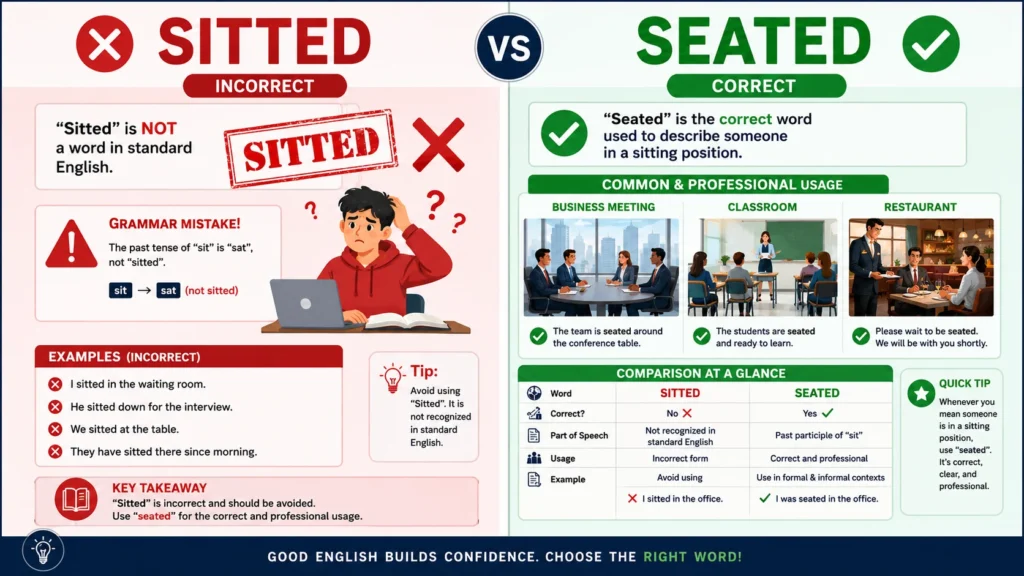
“Sitted” and “seated” both relate to sitting, but only “seated” is widely accepted in modern English. “Seated” is the correct past participle and adjective in formal and everyday writing, while “sitted” is rare, outdated, or considered incorrect in most situations.
If you have ever written “I was sitted on the chair” and wondered whether it sounds right, you are not alone. This is one of those small English mistakes that confuses thousands of learners because both “sitted” and “seated” seem like they should work. After all, they both come from the idea of sitting down.
But here is the truth: in modern English, “sitted” is almost always incorrect, while “seated” is a proper and commonly used word in specific contexts.
This confusion happens because English does not always follow neat grammar patterns. Many learners assume that if walk → walked, then sit → sitted should also be correct. But sit is an irregular verb, and its correct past tense is sat, not sitted. That is exactly why this pair creates so much confusion in emails, essays, exams, workplace writing, and everyday conversation.
Knowing the difference between sitted vs seated is more than just a grammar detail. It helps you write more naturally, avoid awkward sentences, and sound more fluent in both formal and informal English. It also prevents one of the most common learner mistakes in school assignments, professional writing, and spoken communication.
In this guide, we will break down “sitted” or “seated” in a simple, practical way. You will learn what each word means, which one is grammatically correct, where learners often go wrong, how native speakers actually use these forms, and the exact sentence patterns you can confidently use in real life. We will also cover examples, common mistakes, regional usage, and quick practice exercises so you can remember the difference easily.
Quick Answer About Sitted or Seated
Here is the simple answer:
| Word | Correct in Modern English? | Common Usage |
|---|---|---|
| Sitted | Rarely | Mostly incorrect or outdated |
| Seated | Yes | Formal and standard English |
Correct Examples
- Please remain seated during the presentation.
- The guests were seated near the window.
- She was seated beside her friend.
Incorrect or Unnatural Examples
- He was sitted near the door.
- They sitted quietly in class.
The correct past tense of “sit” is “sat,” not “sitted.”
Example:
- Correct: She sat on the chair.
- Incorrect: She sitted on the chair.
Understanding the Word “Sit”
Before comparing “sitted or seated,” it helps to understand the base verb “sit.”
“Sit” is an irregular verb.
| Verb Form | Word |
|---|---|
| Base Form | Sit |
| Past Tense | Sat |
| Past Participle | Sat |
| Present Participle | Sitting |
Examples
- I sit near the front.
- Yesterday, I sat near the window.
- She has sat there before.
- They are sitting quietly.
Notice that “sitted” does not appear in the normal verb forms.
What Does “Seated” Mean?
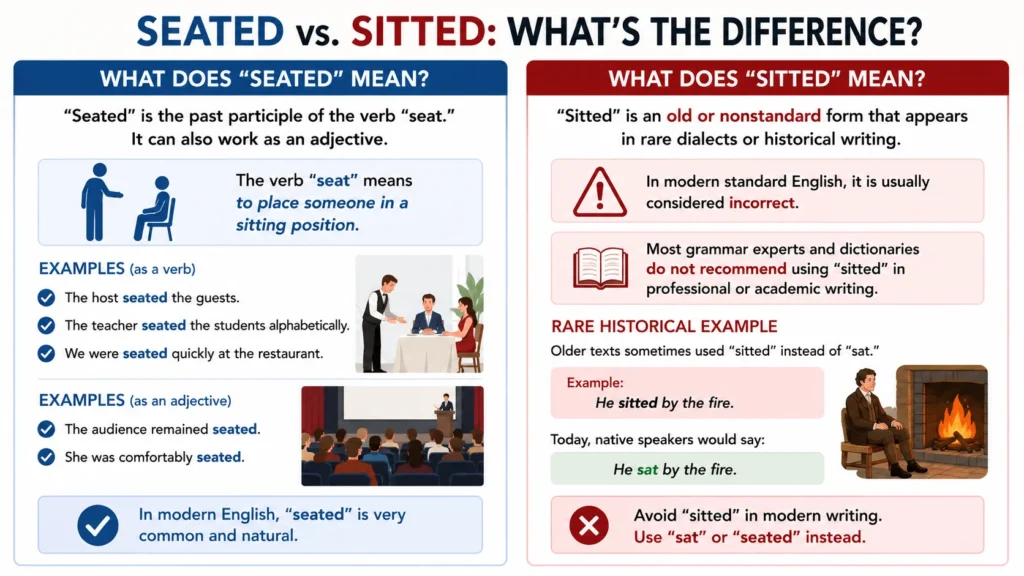
“Seated” is the past participle of the verb “seat.” It can also work as an adjective.
The verb “seat” means to place someone in a sitting position.
Examples
- The host seated the guests.
- The teacher seated the students alphabetically.
- We were seated quickly at the restaurant.
As an adjective:
- The audience remained seated.
- She was comfortably seated.
In modern English, “seated” is very common and natural.
What Does “Sitted” Mean?
“Sitted” is an old or nonstandard form that appears in rare dialects or historical writing. In modern standard English, it is usually considered incorrect.
Most grammar experts and dictionaries do not recommend using “sitted” in professional or academic writing.
Rare Historical Example
Older texts sometimes used “sitted” instead of “sat.”
Example:
- He sitted by the fire.
Today, native speakers would say:
- He sat by the fire.
Why People Confuse Sitted and Seated
There are several reasons why learners confuse these words.
Irregular Verb Rules
English has many irregular verbs.
| Base Verb | Incorrect Guess | Correct Form |
|---|---|---|
| Sit | Sitted | Sat |
| Go | Goed | Went |
| Eat | Eated | Ate |
Learners often expect all verbs to follow the “add ed” rule.
Similar Sound
“Sitted” and “seated” sound somewhat alike. This causes confusion, especially for nonnative speakers.
Translation Problems
Some languages create past tense forms differently. Direct translation may lead people to write “sitted.”
Online Mistakes
Incorrect grammar spreads quickly online through social media posts, comments, and informal writing.
Sitted or Seated in Grammar
Understanding grammar makes the difference much clearer.
Sit vs Seat
| Verb | Meaning |
|---|---|
| Sit | To rest on a chair or surface |
| Seat | To place someone in a seat |
Examples
- Please sit down.
- The waiter seated us near the window.
Past Forms
| Base Verb | Past Tense | Past Participle |
|---|---|---|
| Sit | Sat | Sat |
| Seat | Seated | Seated |
Correct Sentences
- He sat quietly.
- The manager seated the visitors.
Incorrect Sentences
- He sitted quietly.
- The manager sat the visitors.
(Possible in casual speech, but less formal.)
When to Use “Seated”
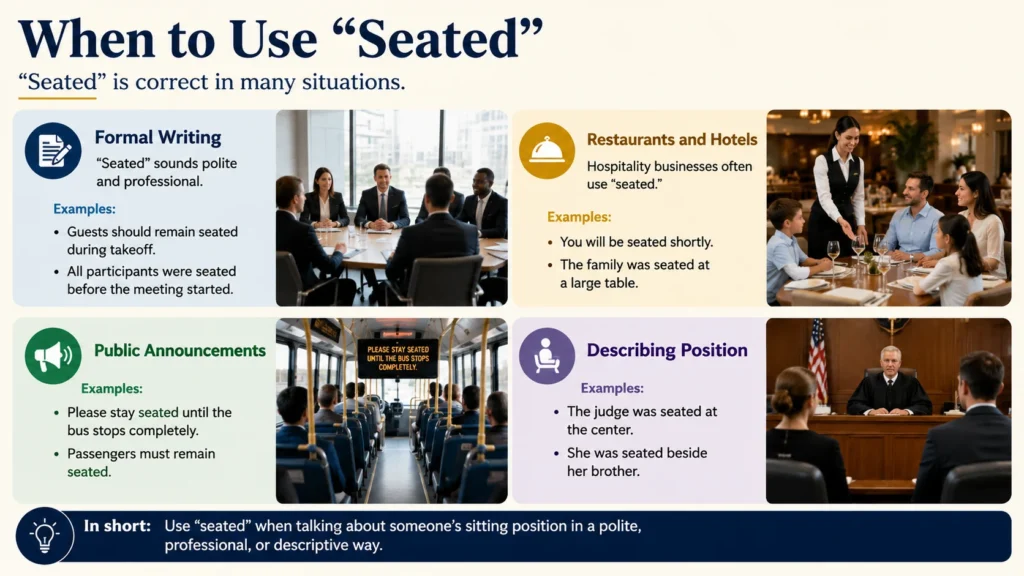
“Seated” is correct in many situations.
Formal Writing
“Seated” sounds polite and professional.
Examples:
- Guests should remain seated during takeoff.
- All participants were seated before the meeting started.
Restaurants and Hotels
Hospitality businesses often use “seated.”
Examples:
- You will be seated shortly.
- The family was seated at a large table.
Public Announcements
Examples:
- Please stay seated until the bus stops completely.
- Passengers must remain seated.
Describing Position
Examples:
- The judge was seated at the center.
- She was seated beside her brother.
When “Sitted” May Appear
Although uncommon, “sitted” can appear in limited cases.
Historical Literature
Older English texts may contain “sitted.”
Regional Dialects
Some dialects or informal speech communities still use it.
Nonstandard English
English learners sometimes use “sitted” accidentally.
However, it should generally be avoided in:
- Academic writing
- Business writing
- Professional communication
- Exams
- Formal speaking
Seated as an Adjective
One important reason “seated” is so common is that it functions naturally as an adjective.
Examples
- A seated audience
- Seated passengers
- Seated guests
Comparison
| Sentence | Natural? |
|---|---|
| The seated audience listened carefully. | Yes |
| The sitted audience listened carefully. | No |
Real World Examples of Sitted or Seated
In Schools
Correct:
- Students remained seated during the lecture.
Incorrect:
- Students remained sitted during the lecture.
In Airplanes
Correct:
- Please stay seated while the seatbelt sign is on.
Incorrect:
- Please stay sitted while the seatbelt sign is on.
In Offices
Correct:
- The clients were seated in the waiting room.
Incorrect:
- The clients were sitted in the waiting room.
In Everyday Conversation
Correct:
- I sat near the door.
- We were seated quickly.
Incorrect:
- I sitted near the door.
Comparison Table Between Sitted and Seated
| Feature | Sitted | Seated |
|---|---|---|
| Standard English | No | Yes |
| Common in Modern English | Rare | Very common |
| Used in Professional Writing | No | Yes |
| Grammatically Accepted | Usually no | Yes |
| Sounds Natural | No | Yes |
| Used as Adjective | No | Yes |
| Seen in Historical Texts | Sometimes | Yes |
Advantages and Disadvantages
Advantages of Using “Seated”
Grammatically Correct
“Seated” follows standard English grammar rules.
Professional Tone
It sounds polished and formal.
Widely Understood
Native and nonnative speakers recognize it easily.
Common in Public Communication
Used in schools, transport, media, and business.
Disadvantages of Using “Seated”
Slightly Formal
In casual speech, some people prefer simpler forms like “sat.”
Example:
- Formal: She was seated near me.
- Casual: She sat near me.
Advantages and Disadvantages of “Sitted”
Advantages
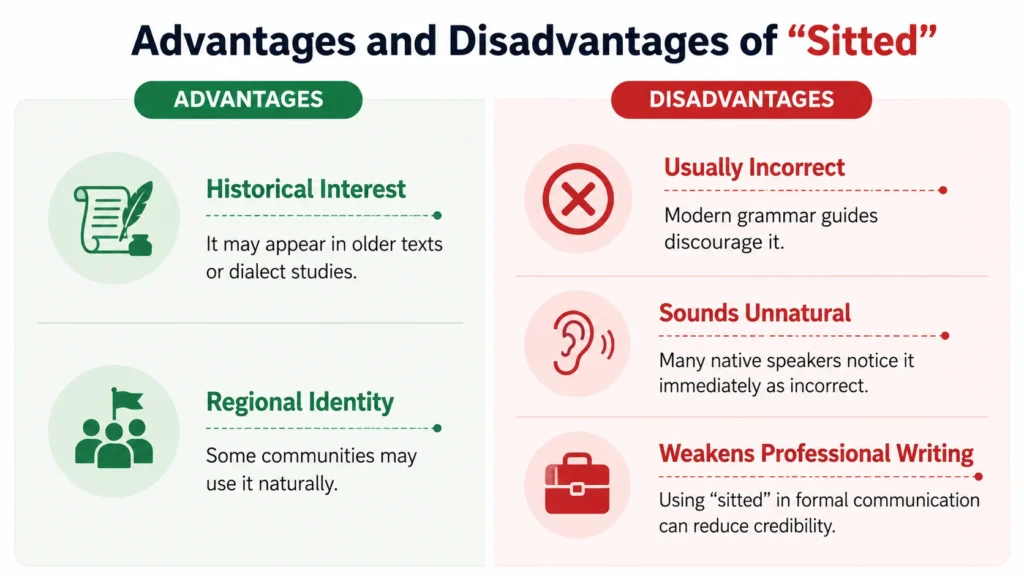
Historical Interest
It may appear in older texts or dialect studies.
Regional Identity
Some communities may use it naturally.
Disadvantages
Usually Incorrect
Modern grammar guides discourage it.
Sounds Unnatural
Many native speakers notice it immediately as incorrect.
Weakens Professional Writing
Using “sitted” in formal communication can reduce credibility.
Common Mistakes With Sitted or Seated
Mistake One
Incorrect:
- I have sitted here before.
Correct:
- I have sat here before.
Mistake Two
Incorrect:
- She was sitted beside me.
Correct:
- She was seated beside me.
Mistake Three
Incorrect:
- They sitted quietly.
Correct:
- They sat quietly.
Mistake Four
Incorrect:
- The passengers were sitted.
Correct:
- The passengers were seated.
How Native Speakers Use These Words
Native English speakers almost never use “sitted” in modern conversation.
Instead, they say:
- Sat
- Sitting
- Seated
Common Native Patterns
| Situation | Natural Expression |
|---|---|
| Past action | Sat |
| Continuous action | Sitting |
| Formal position | Seated |
Examples:
- We sat together.
- He is sitting outside.
- The guests are seated.
Regional and Global Usage
American English
American English strongly prefers “sat” and “seated.”
“Sitted” is considered incorrect in standard writing.
British English
British English follows the same pattern.
Examples:
- She sat quietly.
- The guests were seated.
Indian English
Some English learners in South Asia may accidentally use “sitted,” especially in speech. However, educational systems teach “sat” and “seated” as correct forms.
African English Varieties
Some regional dialects may occasionally use “sitted,” but it remains nonstandard in formal contexts.
Sitted or Seated in Business English
Professional communication requires correct grammar.
Email Example
Correct:
- Guests will be seated upon arrival.
Incorrect:
- Guests will be sitted upon arrival.
Meeting Example
Correct:
- Please remain seated until the presentation ends.
Customer Service Example
Correct:
- You will be seated shortly.
Businesses avoid “sitted” because it sounds unprofessional.
Sitted or Seated in Academic Writing
Schools and universities expect standard English.
Recommended Forms
- Sat
- Seated
- Sitting
Forms to Avoid
- Sitted
Example
Correct:
- The participants were seated in groups.
Incorrect:
- The participants were sitted in groups.
Difference Between Sat and Seated
This is another common confusion.
| Word | Type | Usage |
|---|---|---|
| Sat | Past tense of sit | Everyday action |
| Seated | Past participle/adjective | Formal or passive style |
Examples
Sat
- I sat on the sofa.
- She sat beside me.
Seated
- We were seated near the stage.
- The guests were seated quickly.
Related Grammar Concepts
Irregular Verbs
“Sit” belongs to a group of irregular verbs.
| Base | Past | Past Participle |
|---|---|---|
| Begin | Began | Begun |
| Drink | Drank | Drunk |
| Sit | Sat | Sat |
Passive Voice
“Seated” often appears in passive voice.
Example:
- The guests were seated by the host.
Participial Adjectives
“Seated” can describe a noun directly.
Example:
- A seated passenger
Simple Analogies to Understand the Difference
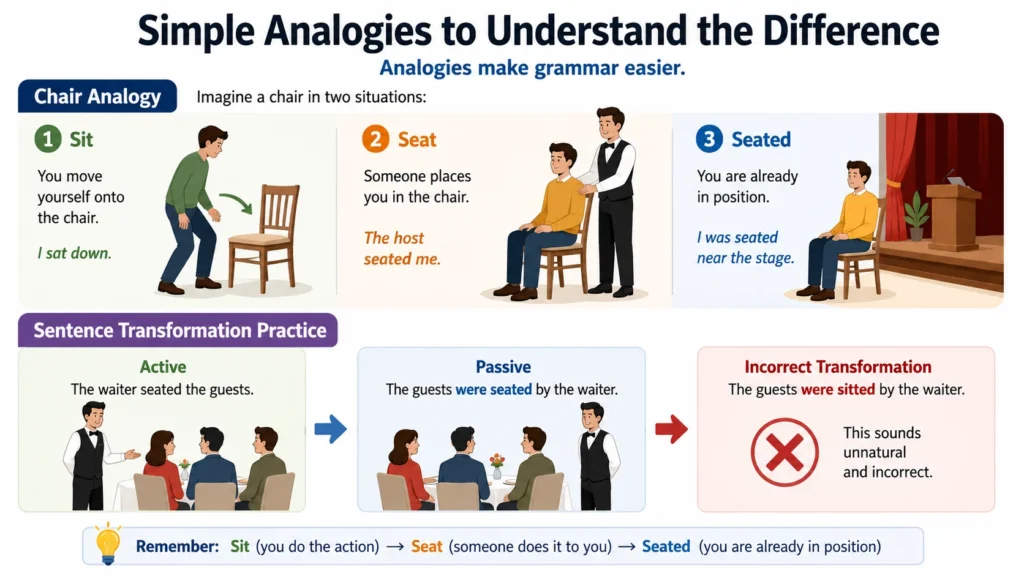
Analogies make grammar easier.
Chair Analogy
Imagine a chair in two situations:
Sit
You move yourself onto the chair.
- I sat down.
Seat
Someone places you in the chair.
- The host seated me.
Seated
You are already in position.
- I was seated near the stage.
Sentence Transformation Practice
Active to Passive
Active
- The waiter seated the guests.
Passive
- The guests were seated by the waiter.
Incorrect Transformation
- The guests were sitted by the waiter.
This sounds unnatural and incorrect.
Exercises With Answers
Exercise One
Choose the correct word.
- The students were _____ before class began.
- I _____ beside my friend yesterday.
- The host _____ the guests quickly.
- Please remain _____ during the show.
Answers
- seated
- sat
- seated
- seated
Exercise Two
Correct the sentence.
- He sitted near the teacher.
- We were sitted at the back.
- They have sitted there before.
Correct Answers
- He sat near the teacher.
- We were seated at the back.
- They have sat there before.
Exercise Three
Fill in the blanks.
- The audience remained _____.
- She _____ quietly in the corner.
- The manager _____ us near the entrance.
Answers
- seated
- sat
- seated
Beginner Tips for Remembering the Difference
Remember This Rule
- Sit → Sat
- Seat → Seated
Avoid Adding “Ed” to “Sit”
Do not say:
- Sitted
Instead say:
- Sat
Think About Formal Situations
In formal places like restaurants, airports, and meetings, “seated” is common.
Advanced Grammar Notes
Why “Seated” Sounds More Formal
“Seated” often appears in passive constructions and official announcements.
Examples:
- All guests are requested to remain seated.
- The delegates were seated according to rank.
This creates a more professional tone.
Stylistic Difference
Casual
- We sat near the window.
Formal
- We were seated near the window.
Both are correct, but the second sounds more polished.
Common Questions Learners Ask
Is “Sitted” Ever Correct?
In very limited historical or dialect contexts, yes. But in modern standard English, it should generally be avoided.
Why Does “Seated” Sound Better?
Because it matches accepted grammar patterns in modern English.
Can “Seated” Replace “Sat”?
Sometimes, but not always.
Example:
- I sat down.
Natural and simple. - I was seated down.
Unnatural.
Real Life Situations
At a Wedding
Correct:
- Guests were seated before the ceremony.
In a Classroom
Correct:
- Students sat quietly.
At the Cinema
Correct:
- We were seated in the front row.
On Public Transport
Correct:
- Passengers must remain seated.
Related Comparisons
Sit vs Seat
| Sit | Seat |
|---|---|
| Usually intransitive | Usually transitive |
| You do it yourself | Someone places another person |
| Example: I sat down | Example: The usher seated us |
Sat vs Seated
| Sat | Seated |
|---|---|
| Casual | Formal |
| Action focused | Position focused |
| Common in conversation | Common in announcements |
Why Correct Usage Matters
Using correct grammar improves:
- Professional image
- Academic performance
- Communication clarity
- Confidence in speaking and writing
Incorrect grammar may confuse readers or make writing appear less polished.
Practical Writing Examples
Formal Notice
- Visitors should remain seated during the performance.
Casual Conversation
- We sat together at lunch.
News Report
- The dignitaries were seated in the front section.
Travel Announcement
- Please stay seated until the aircraft stops fully.
FAQs
Is “sitted” grammatically correct?
In modern standard English, “sitted” is usually considered incorrect. Use “sat” or “seated” instead.
Should I use “sat” or “seated”?
Use “sat” for normal actions and “seated” for formal or passive situations.
Why do people say “sitted”?
Some learners apply regular verb rules incorrectly or hear it in dialect speech.
Can “seated” be used as an adjective?
Yes. Examples include “seated guests” and “seated passengers.”
Is “sitted” used in British English?
Standard British English prefers “sat” and “seated,” not “sitted.”
What is the past tense of “sit”?
The correct past tense is “sat.”
Can I use “seated” in business writing?
Yes. “Seated” is professional and widely accepted in formal English.
What is the difference between “sit” and “seat”?
“Sit” means to place yourself down. “Seat” means to place another person in a seat.
Why is “seated” common in restaurants?
Restaurants use formal and polite language, so “You will be seated shortly” sounds professional.
How can I remember the difference between sitted or seated?
Remember this pattern:
- Sit → Sat
- Seat → Seated
Never use “sitted” in formal writing.
Conclusion
Understanding the difference between “sitted or seated” is important for clear and correct English. In modern grammar, “seated” is the accepted and professional form, while “sitted” is rare, outdated, or generally incorrect. The verb “sit” forms its past tense as “sat,” not “sitted,” which is why sentences like “I sat there” are correct.
“Seated” is especially useful in formal communication, public announcements, hospitality settings, and business writing. It also works naturally as an adjective, as seen in phrases like “seated guests” or “seated audience.”
To avoid mistakes, remember the simple grammar pattern:
- Sit → Sat
- Seat → Seated
Practice using these forms in real conversations, emails, and writing exercises. Reading professional English content can also help you recognize natural sentence patterns. With regular practice, choosing between “sitted or seated” will become easy and automatic.

Victoria Lane is a grammar-focused writer at GramBrix.com, passionate about helping readers master the rules of language. She provides clear explanations and practical examples that make writing more accurate, polished and confident.